SNAP Benefit Adjustments October 2026: What Changes, Who Qualifies & New Amounts
Quick Answer
On October 1, 2026, SNAP benefits increase by an average of 2.9% through the annual Cost-of-Living Adjustment (COLA). The maximum monthly benefit for a family of four rises to $1,023 in the 48 contiguous states. The minimum benefit increases to $25. Income limits, deductions, and asset rules also change. Most recipients will see a modest increase in monthly benefits.
Max $306 (1 person); $1,023 (family of 4); min $25 — effective Oct. 1, 2026
Application
State SNAP offices, online portals, phone, mail, in person
Processing Time
30 days standard; 7 days expedited
Renewal
Varies by state and household; recertification required
Available States
All 50 states, DC, Guam, Virgin Islands
Last Updated
September 18, 2026
What Is This Program?
SNAP (Supplemental Nutrition Assistance Program) is the federal food assistance program formerly known as “food stamps.” It provides monthly benefits on an Electronic Benefits Transfer (EBT) card to help low-income households purchase nutritious food. The program is funded by the USDA Food and Nutrition Service (FNS) and administered by state agencies. SNAP benefits can be used for breads, cereals, fruits, vegetables, meats, fish, poultry, dairy products, and seeds or plants that produce food.
What the October adjustment is: Every October 1, the USDA implements its annual Cost-of-Living Adjustment (COLA) for SNAP. This adjustment changes maximum allotments, income eligibility standards, deductions, and other program parameters. The October 2026 adjustment is based on the FY 2027 COLA and is effective from October 1, 2026, through September 30, 2027. The adjustment reflects changes in the cost of food and inflation measured by the Thrifty Food Plan (TFP), which estimates how much it costs to provide nutritious, low-cost meals for a household.
The October 2025 COLA vs. October 2026 COLA: The October 2025 COLA was the FY2026 adjustment, effective October 1, 2025, through September 30, 2026. The October 2026 COLA is the FY2027 adjustment, effective October 1, 2026, through September 30, 2027. Both are sometimes referred to as “October adjustments” because they take effect on October 1 of each year.
Who Qualifies?
SNAP eligibility depends on income, resources, household size, and individual circumstances. The October 2026 COLA raises some income limits, which may allow more households to qualify.
Who Qualifies
Low-income households whose gross monthly income falls at or below 130% of the Federal Poverty Level (FPL) — or higher in states with Broad-Based Categorical Eligibility (BBCE)
Households with elderly members (60+) — may only need to meet net income limits, not gross
Households with disabled members receiving certain disability payments — same exemption from gross income test
Legal immigrants who meet specific immigration status requirements
College students who meet one of several exemptions (working 20+ hours/week, receiving work-study, having dependent children, etc.)
Who Does NOT Qualify
Households with gross income above 130% FPL (or the BBCE threshold in their state) — unless all members are elderly or disabled
Able-bodied adults without dependents (ABAWDs) aged 18–64 who fail to meet work requirements (80 hours/month of work, training, or volunteering) — limited to 3 months of benefits in a 36-month period
Most full-time college students who do not meet an exemption
Undocumented immigrants — though their U.S. citizen children may still qualify
Individuals disqualified for intentional program violations
Individuals on strike — may be ineligible
Source: USDA FNS, state SNAP agencies
Income Limits
FY2027 Income Limits (Effective October 1, 2026)
The October 2026 COLA raises income limits for SNAP eligibility. These are the new federal poverty level (FPL) standards for the 48 contiguous states, Washington, D.C., Guam, and the U.S. Virgin Islands:
Higher income standard for elderly/disabled separate households (165% FPL): For households where elderly or disabled individuals are a separate household, the gross monthly income limits are higher:
Household Size
FY2027 Gross Monthly Income Limit (165% FPL)
1
$2,195
2
$2,978
3
$3,760
4
$4,542
5
$5,324
6
$6,106
7
$6,888
8
$7,670
Each additional
+$782
Source: USDA FNS FY2027 COLA
Asset Limits
The October 2026 COLA also adjusts asset limits for SNAP households. Asset limits apply to households that are not categorically eligible through BBCE or other programs.
Household Type
FY2026 Asset Limit
FY2027 Asset Limit
Standard household
$3,000
$3,000
Household with member aged 60+ or disabled
$4,500
$4,500
Note: These limits did not change from FY2026 to FY2027. The October 2026 COLA did not adjust the standard asset limits. However, the substantial lottery/gambling winnings threshold was updated.
States with BBCE: In states that use Broad-Based Categorical Eligibility (BBCE), most households are exempt from the asset test entirely. Contact your state SNAP agency to determine if BBCE applies to your household.
Source: USDA FNS, North Dakota SNAP Policy Manual
Household Requirements
SNAP defines a “household” as a group of people who live together and purchase and prepare food together. Key rules:
Married couples living together must apply together
Children under 22 living with parents must be in the same household
Roommates who purchase and prepare food separately can apply as separate households
Elderly or disabled individuals living with others may be able to purchase and prepare food separately and apply as their own SNAP household
Students living in dormitories or on-campus housing may apply individually if they meet student exemptions
Citizenship Rules
To receive SNAP, you must be a U.S. citizen or a qualified alien meeting specific immigration criteria. All household members must provide or apply for a Social Security number before certification.
Qualified aliens include:
Lawful Permanent Residents (green card holders) — subject to a waiting period or 40 qualifying work quarters
Refugees and asylees
Cuban/Haitian entrants
Certain battered immigrants
Veterans and active-duty military members and their spouses
The 2025 One Big Beautiful Bill Act (OBBBA) tightened immigration eligibility rules, stripping SNAP eligibility from some legal non-citizens who previously qualified. These changes took effect in January 2026.
Source: USDA FNS
Immigration Eligibility
Who may qualify as a legal immigrant:
Green card holders (after 5 years or with 40 qualifying work quarters)
Refugees and asylees (immediately eligible)
Veterans and active-duty service members (immediately eligible)
Certain Cuban/Haitian entrants
Who likely does NOT qualify:
Undocumented immigrants
Temporary Protected Status (TPS) holders (under OBBBA rules)
Some parolees and deferred action recipients
Important: U.S. citizen children in immigrant families can receive SNAP benefits even if their parents are not eligible.
State Differences
The October 2026 COLA applies nationwide, but SNAP eligibility and benefit amounts vary by state due to differences in:
Feature
Variation by State
BBCE adoption
Some states use BBCE (higher income limits, no asset test); others do not
Maximum allotments
Alaska, Hawaii, Guam, and Virgin Islands have higher maximums
Deductions
Standard deduction, shelter deduction, and utility allowances vary
Certification periods
12 months standard; some states offer longer or shorter periods
Work requirement waivers
Some states have waivers for ABAWD time limits
Food restrictions
Some states restrict soda, candy, or energy drinks (e.g., Louisiana)
Example: In Louisiana, SNAP recipients cannot use benefits to purchase soft drinks, energy drinks, or candy under a waiver effective February 18, 2026. In Colorado, a similar waiver was approved to take effect in November 2026. No such statewide restrictions exist in most other states.
Source: State SNAP agencies, USDA FNS
Required Documents
You will need to provide verification for the following. Requirements vary slightly by state:
What Must Be Verified
Examples of Proof
Identity
Driver’s license, work/school ID, state ID, passport, voter registration
Pay stubs, tax returns, employer letters, Social Security award letters
Self-Employment Income
Business records, ledgers, tax returns
Resources/Assets
Bank statements (if applicable)
Shelter Costs
Rent receipts, mortgage statements, utility bills
Dependent Care Costs
Child care receipts, provider statements
Medical Expenses (elderly/disabled)
Medical bills, prescription receipts
Immigration Status
USCIS documentation (if applicable)
Source: State SNAP agencies
How to Apply
Application Methods
Online: Most states offer online SNAP applications through their state portal. Visit your state’s SNAP website or Benefits.gov to find your state’s portal.
By Phone: Many state SNAP agencies accept applications by phone. Contact your state’s SNAP office.
In Person: Visit a local SNAP office or Department of Social Services.
By Mail/Fax: Download a paper application and submit it to your state SNAP agency.
Step-by-Step Application Process
Gather documents — Collect proof of identity, income, residence, and expenses
Complete the application — Provide all required information about your household
Submit the application — Online, by phone, in person, or by mail
Complete the interview — Most applicants must complete an eligibility interview
Provide verification — Submit any missing documents requested by the agency
Receive determination — The agency will notify you of its decision within 30 days
Tip: Online applications are typically the fastest method. Upload documents directly through the portal to reduce processing time.
Processing Time
Processing Type
Timeframe
Who Qualifies
Standard
30 days
Most applicants
Expedited
7 days
Households with very low income or emergency situations
Expedited processing applies if your household has less than $150 in monthly gross income and less than $100 in liquid resources, or if your combined income and resources are less than your monthly rent plus utilities.
Payment Schedule
SNAP benefits are deposited monthly onto your EBT card. The specific deposit date varies by state:
New York: 1st through 10th of the month (based on case number)
Louisiana: 1st through 23rd of the month (based on case number)
Washington, D.C.: Based on the first letter of your last name
Other states: Varies by state and case number
Payment frequency: Monthly. Unused benefits remain on the EBT card for up to 12 months.
Renewal Process
SNAP certification periods vary by state and household. Most households must recertify every 12 months. Some households — particularly those with all elderly or disabled members — may receive longer certification periods.
Simplified reporting: Many states offer simplified reporting, which requires households to report changes only when income exceeds a certain threshold.
Recertification process:
Receive notice of expiration before certification ends
Complete recertification form (online, by phone, or by mail)
Complete recertification interview (if required)
Submit updated verification documents
Receive new certification period
Source: State SNAP agencies
Reasons Applications Are Denied
Income exceeds limits — gross income above 130% FPL (or BBCE threshold)
Missing required documents — failure to provide verification
Missed interview — failing to complete the eligibility interview
Asset limits exceeded — in non-BBCE states
Work requirement non-compliance — ABAWDs who fail to meet 80 hours/month
Immigration status — not meeting qualified alien requirements
Student status — full-time students without an exemption
Intentional program violation — prior fraud disqualification
Failure to provide SSN — required for all household members
Striking — individuals on strike may be ineligible
Appeals Process
If your SNAP application is denied or benefits are reduced, you have the right to appeal.
Steps:
Review your notice — The denial or reduction notice explains why and how to appeal
Request a fair hearing — Follow the instructions on your notice, typically within 90 days
Prepare for the hearing — Gather documents and evidence supporting your case
Attend the hearing — You can represent yourself or bring a representative
Receive decision — The hearing officer will issue a decision
Continuing benefits: If you are currently receiving benefits and request a fair hearing before your benefits are reduced, you may continue receiving benefits at the current level until the hearing decision.
Source: State SNAP agencies
Common Mistakes
Not reporting all income — including self-employment, gig work, and cash income
Forgetting to report household changes — new members, moves, income changes
Missing the interview — this is a required step
Not submitting documents on time — gather documents before applying
Assuming you don’t qualify — the October COLA raises income limits, so more households may qualify
Not applying for expedited service — if you’re in an emergency, ask about 7-day processing
Failing to recertify on time — benefits stop if you miss your recertification
Not understanding work requirements — ABAWDs must meet 80 hours/month or qualify for an exemption
Not reporting a lost EBT card immediately — call EBT customer service right away
Not appealing a denial — you have the right to challenge decisions
Recent Changes
October 2026 COLA (Effective October 1, 2026)
The annual Cost-of-Living Adjustment increases:
Maximum allotments — Family of four: $994 → $1,023
Minimum benefit — $24 → $25
Income limits — Gross income limit for family of four: $3,483 → $3,575
Deductions — Standard deduction, shelter deduction, and utility allowances adjusted
One Big Beautiful Bill Act (OBBBA) — Signed July 2025
Key changes affecting SNAP:
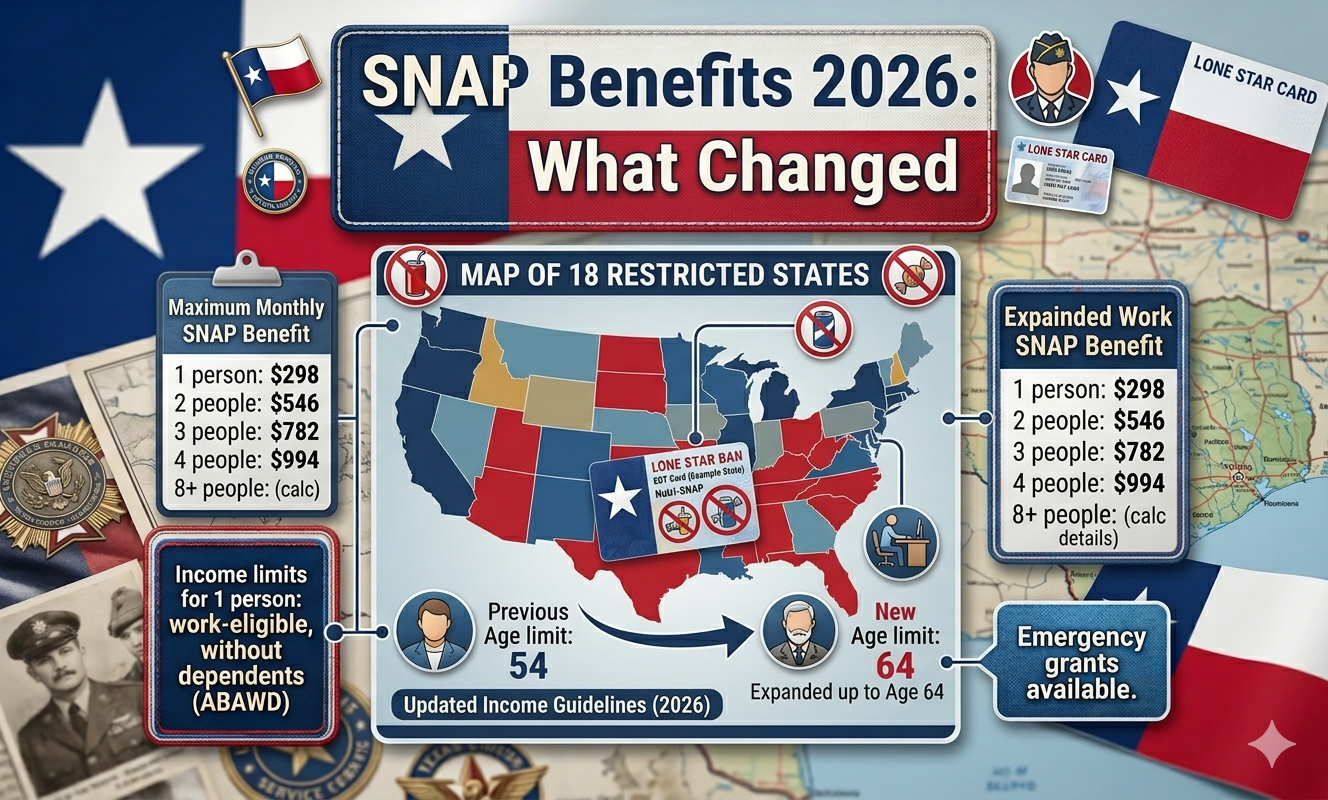
Expanded work requirements for ABAWDs aged 18–64 (previously 18–54 in many areas)
Removed automatic exemptions for veterans, homeless individuals, and former foster youth
Tightened immigration eligibility — some legal non-citizens lost eligibility
Reduced federal administrative funding from 50% to 25% starting October 1, 2026
State cost-sharing for benefit errors — states may pay 5–15% of benefit costs if error rates exceed thresholds
ABAWD Time Limit — April 2026 to March 2029
The current SNAP time limit period for ABAWDs runs from April 2026 through March 2029. ABAWDs can only receive SNAP for three months in this 36-month period unless they meet the work requirement (80 hours/month) or qualify for an exemption.
Member of a federally recognized Native American tribe
Source: USDA FNS, state SNAP agencies
Frequently Asked Questions
What changes on October 1, 2026, for SNAP?
SNAP benefits and income limits increase through the annual Cost-of-Living Adjustment. Maximum benefits for a family of four rise from $994 to $1,023. The minimum benefit increases from $24 to $25. Income limits and deductions also increase.
How much will my SNAP benefits increase in October 2026?
The overall increase is approximately 2.9%. A single person receives about $8 more per month. A family of four receives about $29 more per month. Actual increases depend on household income and deductions.
What is the maximum SNAP benefit for a family of four in October 2026?
The maximum monthly SNAP benefit for a family of four in the 48 contiguous states and Washington, D.C., is $1,023, effective October 1, 2026. This is up from $994 in FY2026.
What is the minimum SNAP benefit in October 2026?
The minimum monthly SNAP benefit increases to $25 for one- and two-person households that pass the net income test. This is up from $24 in FY2026.
What are the new SNAP income limits for October 2026?
The gross monthly income limit (130% FPL) for a family of four is $3,575. The net monthly income limit (100% FPL) is $2,750. For a single person, the gross limit is $1,729 and the net limit is $1,330.
Do asset limits change in October 2026?
The standard asset limits remain $3,000 for most households and $4,500 for households with elderly or disabled members. States with Broad-Based Categorical Eligibility (BBCE) typically exempt most households from the asset test.
What are the work requirements for SNAP in 2026?
Able-bodied adults without dependents (ABAWDs) aged 18–64 must work, train, or volunteer at least 80 hours per month to receive SNAP beyond three months in a 36-month period. Exemptions are available for certain caregivers, pregnant women, students, veterans (with limitations), and others.
Has the October 2026 COLA changed work requirements?
No. The October 2026 COLA adjusts benefit amounts and income limits. Work requirements were changed by the One Big Beautiful Bill Act (OBBBA), which took effect in January 2026, separate from the annual COLA.
How do I check if I qualify for SNAP after the October 2026 adjustment?
Use your state’s SNAP eligibility screening tool or contact your state SNAP agency. The higher income limits may make more households eligible. You can also visit Benefits.gov for general information.
When will I see the increased benefits on my EBT card?
The increased benefits take effect October 1, 2026. Your first deposit reflecting the new amount will be on your regular monthly deposit date in October or November, depending on your state’s issuance schedule.
Do SNAP benefits increase every October?
Yes. SNAP maximum allotments, income limits, and deductions are adjusted annually on October 1 based on the Cost-of-Living Adjustment (COLA). The adjustment reflects changes in food costs and inflation.
What is the Thrifty Food Plan and how does it affect SNAP?
The Thrifty Food Plan is the USDA’s estimate of how much it costs to provide nutritious, low-cost meals for a household. Maximum SNAP allotments are based on the cost of this plan, which is reevaluated every five years and adjusted annually for inflation.
Key Takeaways
October 1, 2026: SNAP benefits increase by approximately 2.9% through the annual COLA
Maximum benefit (family of 4): $1,023/month — up from $994
Minimum benefit: $25/month — up from $24
Gross income limit (family of 4): $3,575/month — up from $3,483
Net income limit (family of 4): $2,750/month — up from $2,680
Asset limits: $3,000 standard; $4,500 for elderly/disabled — unchanged
Work requirements: ABAWDs aged 18–64 must meet 80 hours/month; exemptions available
OBBBA changes: Expanded work requirements, tightened immigration rules, reduced federal administrative funding
State differences: BBCE, food restrictions, and certification periods vary by state
Apply or check eligibility: Use your state’s SNAP portal or Benefits.gov