Small Social Security Payment: What It Means and Why
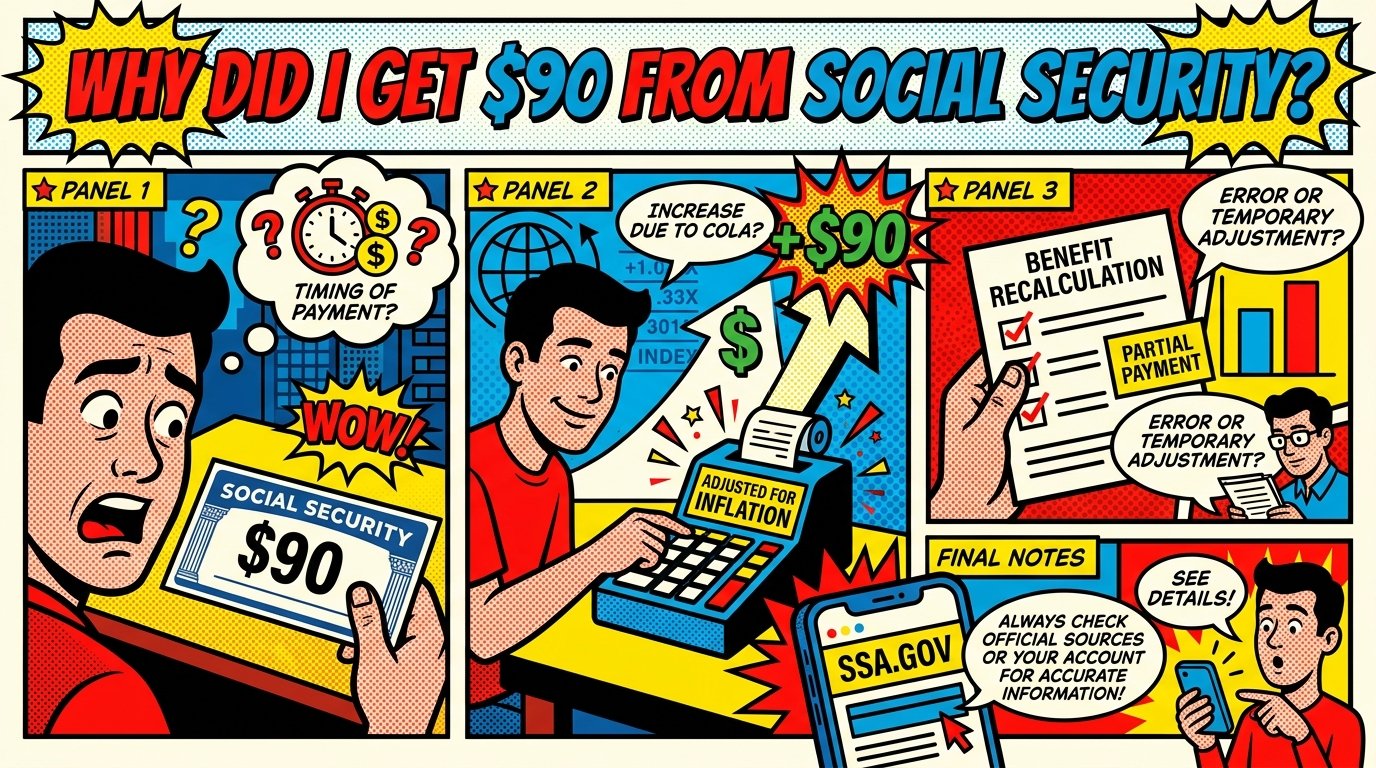
A $90 payment from Social Security is most likely a partial-month benefit, a retroactive adjustment, a Medicare premium refund, or a residual payment after a benefit change. It could also be a small survivor benefit, a lump-sum death payment, or a correction for an overpayment or underpayment. You should check your my Social Security account online or call 1-800-772-1213 to confirm the reason.
Quick Facts
Item
Information
Program
Social Security (Retirement, SSDI, SSI, Survivors)
A $90 payment from Social Security is not a standard monthly benefit amount for any program in 2026. It is almost certainly a partial payment, an adjustment, or a one-time distribution.
The Social Security Administration issues payments through several programs:
Retirement Insurance Benefits (RIB): Monthly benefits for retired workers, average $1,976 per month in 2026
Survivors Benefits: Monthly benefits for widows, widowers, and children
Lump-Sum Death Payment: A one-time payment of $255 to a surviving spouse or child
A $90 payment does not match the standard monthly amount for any of these programs. That means it is likely one of the following: a partial-month payment, a retroactive adjustment, a Medicare premium refund, a residual payment after a benefit change, or a small survivor benefit.
Common Reasons You Received $90 from Social Security
There are at least 10 common reasons why Social Security would send you a $90 payment. Here is each one explained in plain English.
1. Partial-Month Benefit (First or Last Month of Eligibility)
Most likely explanation. Social Security pays benefits for full months only. If you became eligible mid-month, or your benefits ended mid-month, you receive a prorated payment for that partial month.
Example: If your full monthly benefit is $1,800 and you became eligible on the 26th of the month, you would receive approximately 5 days of benefits. That could be around $90.
How to confirm: Check your award letter or your my Social Security account. The payment history will show “partial month” or a prorated amount.
2. Medicare Premium Refund or Adjustment
Very common. If you pay Medicare Part B premiums through Social Security, changes in your premium can result in a refund.
Example: If your Medicare premium was reduced retroactively, Social Security may issue a refund for the difference. A $90 refund could represent a few months of overpaid premiums.
How to confirm: Check your Medicare premium notice or call 1-800-MEDICARE. The refund will appear as a separate line item in your Social Security payment history.
Common. If SSA discovers they underpaid you in a previous month or year, they issue a corrective payment.
Example: If your benefit should have been $90 higher for one month due to a cost-of-living adjustment (COLA) that was applied late, you would receive a $90 catch-up payment.
How to confirm: You will typically receive a notice explaining the adjustment. The payment history in your my Social Security account will show the reason.
Common. If your benefits ended — due to death, marriage, work, or another reason — SSA may issue a final payment for benefits owed before termination.
Example: If your SSI benefits stopped because your income increased, but you were owed benefits for part of the final month, you would receive a residual payment.
How to confirm: Look for a termination notice or a final payment letter from SSA.
5. Overpayment Recovery Reversal
Possible. If SSA was withholding money from your benefits to recover an overpayment, and that overpayment was later waived or reversed, you would receive the withheld amount back.
Example: If SSA withheld $90 from your monthly benefit for three months to recover an overpayment, and the overpayment was later found to be invalid, you would receive a $90 refund.
How to confirm: Check for a waiver approval notice or a reversal letter.
6. Small Survivor Benefit
Possible. Some surviving family members qualify for small monthly benefits, especially children or dependent parents.
Example: A child might receive a small survivor benefit if the deceased parent had low lifetime earnings. A $90 monthly payment is possible but uncommon.
How to confirm: Check your award letter or call SSA to confirm the benefit type.
7. Lump-Sum Death Payment ($255)
**Not $90, but related.** The lump-sum death payment is $255, not $90. However, if there were multiple eligible survivors, the payment might be split.
Example: If two children are eligible for the lump-sum death payment, each might receive $127.50. A $90 amount is unlikely but possible if other adjustments were applied.
How to confirm: Check for a lump-sum death payment notice from SSA.
8. Retirement Benefit for a Low-Earning Worker
Uncommon but possible. A worker with very low lifetime earnings could have a monthly retirement benefit as low as $90.
Example: A worker who only worked a few years at low wages might have a small retirement benefit. However, if they also qualify for SSI, the SSI payment would be reduced by the amount of the Social Security benefit.
How to confirm: Check your benefit verification letter or my Social Security account.
9. SSI Payment After Income Change
Possible. If your SSI benefit was reduced because of other income, and that income later decreased, SSA might issue a catch-up payment.
Example: If your SSI was reduced by $90 for a month because of countable income, and that income was later determined to be non-countable, you would receive a $90 adjustment.
How to confirm: Check your SSI award letter or contact your local SSA office.
10. Stimulus or Special Payment (Rare)
Rare. The federal government has issued stimulus payments in the past, but these are typically not from Social Security directly. A $90 payment could be a state-level stimulus or rebate, but it would not come from SSA.
How to confirm: Check the payment description on your bank statement. If it says “IRS” or a state agency, it is not a Social Security payment.
How to Find Out the Exact Reason
The fastest way to find out why you received $90 is to check your my Social Security account online or call SSA.
Call 1-800-772-1213 (TTY 1-800-325-0778). Wait times are typically shorter in the morning or mid-week. Have your Social Security number ready.
Step 3: Check Your Bank Statement
Look at the payment description. It may say “SOC SEC” or “SSA” and include a trace number. This can help you identify the source.
Step 4: Review Your Mail
SSA sends notices for most adjustments. Check for any letters from SSA, especially if the payment was unexpected.
Step 5: Visit a Local SSA Office
If you cannot resolve the issue by phone or online, visit your local Social Security office. Bring identification and any notices you have received.
Who Qualifies for Social Security Payments?
Eligibility depends on the program. Here is a quick breakdown.
Program
Who Qualifies
Typical Monthly Amount
Retirement
Workers 62+ with sufficient work credits
Avg $1,976 (2026)
SSDI
Disabled workers with sufficient work credits
Avg $1,630 (2026)
SSI
Aged, blind, or disabled with limited income/resources
Max $994 (individual)
Survivors
Widows, widowers, children of deceased workers
Varies
Lump-Sum Death
Surviving spouse or child
$255 one-time
A $90 payment does not fit any of these standard amounts. That is why it is almost certainly an adjustment, partial payment, or refund.
Income Limits
SSI has income limits. Retirement, SSDI, and Survivors benefits do not.
SSI Income Limits (2026)
Household Size
Maximum Countable Income
Individual
$994/month
Couple
$1,491/month
Retirement and SSDI: No income limits. You can have any amount of unearned income and still receive benefits. However, if you work while receiving SSDI, your earnings must stay below the Substantial Gainful Activity (SGA) level: $1,690/month for non-blind individuals in 2026.
Survivors: No income limits for most survivor benefits, though benefits may be reduced if the survivor also receives their own retirement or disability benefit.
Asset Limits
Only SSI has asset limits. Retirement, SSDI, and Survivors benefits have no asset limits.
Important: A $90 payment could be a partial payment for someone who recently became eligible as a qualified immigrant, or a survivor benefit for a non-citizen spouse or child.
State Differences
Social Security is a federal program with uniform rules nationwide. There are no state-by-state differences in benefit amounts or eligibility.
However, some states have their own supplemental programs or tax treatment of Social Security benefits. A $90 payment from SSA would not be affected by state rules.
Required Documents
To investigate a $90 payment, you may need:
Document
Purpose
Social Security card
Proof of SSN
Government-issued ID
Proof of identity
Bank statement
Shows the payment and description
Award letter or notice
Explains the payment reason
Medicare card
If the payment relates to Medicare premiums
Prior year tax return
If the payment relates to tax adjustments
How to Apply
You do not apply for an adjustment payment. It is issued automatically when SSA determines it is owed.
If you believe you are owed additional benefits, you can:
File an appeal if you disagree with a benefit amount or decision
Request a waiver if you are being asked to repay an overpayment
Contact SSA to report a change that may affect your benefits
Online Application
You can manage your Social Security benefits online at ssa.gov/myaccount.
SSI: Periodic medical reviews and reporting changes within 10 days
Survivors: No renewal for most beneficiaries; children’s benefits end at age 18 (or 19 if in school)
Reasons Payments Are Adjusted
Payments are adjusted for several reasons. Here are the most common.
Reason
Explanation
COLA
Annual cost-of-living adjustment
Medicare premium change
Part B premium changes
Earnings record correction
Wages added or removed
Overpayment recovery
Withholding to recover overpayment
Underpayment correction
SSA pays back money owed
Benefit recomputation
New earnings increase benefit
Marriage/divorce
Changes eligibility for auxiliary benefits
Death of beneficiary
Final payment to survivor
Appeals Process
If you disagree with a payment decision, you have the right to appeal.
Level
What Happens
Deadline
1. Reconsideration
SSA reviews the decision
60 days
2. ALJ Hearing
Administrative Law Judge hearing
60 days
3. Appeals Council
Council reviews ALJ decision
60 days
4. Federal Court
Lawsuit in federal district court
60 days
For overpayment issues: You can request a waiver (Form SSA-632) if you believe you should not have to repay. You can also request a reconsideration of the overpayment amount.
Common Mistakes
Avoid these mistakes when dealing with an unexpected Social Security payment:
Spending the money before confirming the reason – It could be an overpayment that must be repaid
Ignoring notices from SSA – Important information about adjustments is sent by mail
Not checking your my Social Security account – The payment history often explains the reason
Assuming it is a scam – While scams exist, legitimate SSA payments do occur
Not reporting changes – If your income, resources, or living arrangement changed, report it
Missing appeal deadlines – You have 60 days to appeal most decisions
Not requesting a waiver for overpayments – You may qualify to have repayment waived
Calling the wrong number – Use 1-800-772-1213 for SSA
Not keeping records – Keep copies of all notices and payment records
Assuming you know the reason – Confirm with SSA before acting
Several changes in 2026 affect Social Security payments:
2.8% COLA: Benefits increased by 2.8% effective January 2026. This could result in a small retroactive adjustment if the COLA was applied late to your record.
Medicare Part B premium: The standard Part B premium increased to $202.90 per month in 2026, up from $185.00 in 2025. This could result in a higher deduction from your Social Security check, not a refund.
SSA service improvements: SSA has expanded online services and reduced processing times for many actions.
Overpayment recovery changes: SSA has updated its overpayment recovery procedures, including a new 100% withholding rate for certain overpayments.
Frequently Asked Questions
Why did I get $90 from Social Security?
A $90 payment is most likely a partial-month benefit, a Medicare premium refund, a retroactive adjustment, a residual payment after benefit termination, or a small survivor benefit. It is not a standard monthly benefit amount for any program.
Is $90 a normal Social Security payment?
No. Standard monthly benefits are much higher: $1,976 average for retirement, $1,630 average for SSDI, and $994 maximum for SSI. A $90 payment is almost certainly an adjustment or partial payment.
Can I keep the $90?
You should confirm the reason before spending it. If it is an overpayment, you may be required to repay it. If it is a legitimate adjustment, you can keep it.
How do I find out why I got $90?
Check your my Social Security account at ssa.gov/myaccount, call 1-800-772-1213, or review any notices you received from SSA.
What if I didn’t apply for Social Security?
If you received a payment you did not apply for, it could be a survivor benefit, a Medicare refund, or an error. Contact SSA immediately to clarify.
Could this be a scam?
It is possible, but legitimate SSA payments do occur. Check your my Social Security account or call SSA directly at 1-800-772-1213. Do not call numbers from unsolicited texts or emails.
What is a partial-month benefit?
Social Security pays for full months only. If you became eligible or lost eligibility mid-month, you receive a prorated payment for the partial month.
What is a Medicare premium refund?
If you overpaid Medicare Part B premiums, SSA may issue a refund. This can happen if your premium was reduced retroactively or if you had incorrect withholding.
What is a residual payment?
A residual payment is a final payment issued after your benefits ended, covering benefits owed for a period before termination.
How long does it take to get an adjustment payment?
Adjustment payments are typically issued within 30–90 days of SSA identifying the issue.
Can I appeal if I think the $90 is wrong?
Yes. You have 60 days from the date of a decision notice to file an appeal.
What should I do if I think I was overpaid?
Contact SSA immediately. You may be able to request a waiver (Form SSA-632) or a repayment plan. Do not ignore the issue — overpayments can accrue interest and affect future benefits.
Key Takeaways
A $90 payment from Social Security is not a standard monthly benefit — it is an adjustment, partial payment, or refund
Most likely reasons: partial-month benefit, Medicare premium refund, retroactive adjustment, residual payment, or small survivor benefit
Check your my Social Security account at ssa.gov/myaccount to see the payment reason
Call 1-800-772-1213 if you cannot find the reason online
Do not spend the money until you confirm it is yours — it could be an overpayment
SSA sends notices for most adjustments; check your mail
Partial-month benefits occur when you become eligible or lose eligibility mid-month
Medicare premium refunds are common for people who overpaid Part B premiums
Overpayments must be repaid, but you can request a waiver or repayment plan
You have 60 days to appeal any decision you disagree with