To qualify for EBT (SNAP food stamps), your household generally must earn at or below 130% of the federal poverty level, meet citizenship or eligible immigration status, and satisfy work requirements if applicable. Most households must have assets under $3,000 ($4,750 if someone is 60+ or disabled). Apply through your state SNAP agency, complete an interview, and provide proof of income, identity, and residency. Benefits load onto an EBT card monthly.
Maximum $298 (1 person) to $994 (4 persons); minimum $24 for most states
Application
Online, by mail, fax, or in person at state SNAP office
Processing Time
30 days standard; 7 days for expedited emergency benefits
Renewal
Every 12 months (some households 24 months); recertification required
Available States
All 50 states, DC, Guam, and U.S. Virgin Islands
Last Updated
October 2026
What Is This Program?
EBT (Electronic Benefits Transfer) is the debit card system used to deliver SNAP food stamp benefits. SNAP is the federal food assistance program administered by the USDA Food and Nutrition Service and run by state agencies. The program helps low-income households buy groceries. Benefits are loaded monthly onto an EBT card that works like a debit card at authorized retailers.
SNAP is not cash. You cannot withdraw money from an EBT card, sell benefits, or use them for non-food items like alcohol, tobacco, pet food, household supplies, or hot prepared foods. The card works at grocery stores, supermarkets, farmers markets, and some online retailers that accept EBT.
Who Qualifies?
You qualify for SNAP if your household meets all of the following:
Income: Gross monthly income at or below 130% of the federal poverty level (FPL), and net monthly income at or below 100% FPL after deductions
Citizenship: You are a U.S. citizen, U.S. national, or a qualified immigrant (Lawful Permanent Resident, Cuban/Haitian entrant, COFA citizen, or certain other eligible categories)
Work requirements: Adults 18–64 must meet work or training requirements unless exempt
Assets: Most households must have countable assets under $3,000 ($4,750 if a member is 60+ or disabled)
Household: You live and prepare meals together with the people on your application
Who does NOT qualify:
Households with gross income above 130% FPL (unless eligible for Broad-Based Categorical Eligibility in certain states)
Undocumented immigrants
Most non-citizens without qualified immigrant status
College students enrolled at least half-time who don’t meet an exemption
Able-bodied adults 18–64 who refuse to meet work requirements (after 3 months)
Strikers who are on strike against their employer
Common exceptions:
Households already receiving TANF or SSI may be automatically income-eligible in some states
Households with a member who is elderly (60+) or disabled may face only the net income test, not the gross income test
Victims of domestic violence may qualify for special protections
Homeless individuals can qualify without a fixed address
Income Limits
Your household must pass two income tests — gross and net — unless all members receive TANF, SSI, or are elderly/disabled.
Gross Income Limits (130% FPL, FY2026)
Household Size
Monthly Gross Income
Annual Gross Income
1
$1,696
$20,352
2
$2,292
$27,504
3
$2,888
$34,656
4
$3,483
$41,796
5
$4,079
$48,948
6
$4,675
$56,100
7
$5,270
$63,240
8
$5,866
$70,392
Each additional person: **+$596/month** (or +$7,152/year).
Net Income Limits (100% FPL, FY2026)
Household Size
Monthly Net Income
1
$1,305
2
$1,763
3
$2,221
4
$2,680
5
$3,138
6
$3,596
7
$4,055
8
$4,513
Important: Households where at least one member is 60+ or receiving disability benefits do not have to meet the gross income test. They only need to meet the net income test.
State note: 42 states use Broad-Based Categorical Eligibility (BBCE), which raises the gross income limit to 165%, 185%, or 200% of FPL for households that receive TANF-funded services or meet other criteria. Check your state’s specific limits.
Asset Limits
Most states require households to have countable assets under $3,000. If someone in the household is 60 or older or has a disability, the limit is $4,750.
What counts as an asset:
Bank accounts (checking, savings)
Cash
Stocks and bonds
Certificates of deposit
Retirement accounts (if accessible)
What does NOT count:
Your primary home
One vehicle per adult household member (in most states)
Retirement accounts for elderly members (in many states)
Personal belongings, furniture, clothing
Burial plots
Important: Many states have eliminated the asset test entirely for most households through BBCE. Even if your state has an asset test, you may be exempt if you receive TANF, SSI, or meet other categorical eligibility criteria.
Household Requirements
SNAP defines a “household” as people who live together and purchase and prepare food together. This matters because household size determines your income limit and benefit amount.
Roommates who buy and cook separately (in most cases)
Children under 18 living with a parent (unless married)
Foster children (sometimes)
Boarders
Special household rules:
Elderly and disabled members may be considered a separate household if they purchase and prepare food separately from other members
Homeless individuals can qualify as their own household
Students living with parents may be included in the parent’s household
Citizenship Rules
You must be a U.S. citizen, U.S. national, or meet specific immigration requirements to receive SNAP.
U.S. citizens: All U.S. citizens qualify if they meet income and other requirements. This includes people born in the U.S., naturalized citizens, and U.S. nationals from American Samoa and Swains Island.
Non-citizen U.S. nationals: People born in American Samoa and Swains Island are U.S. nationals and can qualify.
You do NOT need to be a citizen to qualify — but you must fall into one of the eligible immigrant categories.
Immigration Eligibility
Under H.R.1 (enacted July 4, 2025), SNAP eligibility for non-citizens was restricted effective 2026. Only certain categories qualify.
Eligible non-citizens:
Lawful Permanent Residents (LPR) — Green Card holders who have 40 qualifying quarters of work OR are children under 18, OR have been in the U.S. for 5 years (with exceptions for military members and certain others). LPRs who meet work quarter requirements qualify immediately.
Cuban/Haitian entrants — As defined in section 501(e) of the Refugee Education Assistance Act
COFA citizens — Citizens of the Federated States of Micronesia, Republic of the Marshall Islands, and Republic of Palau who lawfully reside in the U.S.
Certain military-connected immigrants — Veterans, active-duty service members, and their spouses and children
Refugees and asylees — After meeting specific criteria
Victims of trafficking and their family members
Iraqi and Afghan special immigrants
No longer eligible (as of 2026):
Non-citizen visitors, tourists, diplomats
Students who enter temporarily with no intention of abandoning foreign residence
Most other non-immigrant categories that previously qualified
Undocumented immigrants do not qualify for SNAP and cannot receive benefits. However, they may apply on behalf of eligible household members (like U.S. citizen children).
State Differences
SNAP is a federal program but states have flexibility in how they administer it. Key differences include:
State Difference
Impact
Broad-Based Categorical Eligibility (BBCE)
42 states raise income limits to 165%, 185%, or 200% FPL for certain households
Asset limits
Many states have eliminated asset tests through BBCE
Standard deduction
Varies by household size and state
Shelter deduction cap
Varies by state (some have no cap)
Utility allowances
Standard Utility Allowance (SUA), Limited Utility Allowance (LUA), and Telephone Utility Allowance amounts vary
Work requirement waivers
Some states have waived work requirements in areas with high unemployment
Online application
46 states accept online applications; 33 allow online recertification
Expedited processing
All states offer 7-day emergency processing but implementation varies
Benefit issuance schedule
EBT deposit dates vary by state (usually based on SSN or case number)
States with BBCE income limits at 200% FPL (most generous): California, Connecticut, Hawaii, Maryland, Massachusetts, Nevada, New Jersey, Rhode Island, Vermont, Washington, and others.
States with no asset test: Most BBCE states have eliminated asset tests for most households.
Required Documents
You must verify your identity, income, household composition, and immigration status (if applicable).
Identity:
Driver’s license or state ID
U.S. passport
Birth certificate
Naturalization certificate
Hospital or doctor records
Proof of address:
Utility bill
Lease or rental agreement
Mortgage statement
Phone bill
Voter registration card
Income:
Pay stubs (last 30 days)
W-2 forms or tax returns
Benefit letters (Social Security, VA, unemployment)
Step 1: Find your state’s SNAP agency. Each state runs its own SNAP program. Search “[your state] SNAP application” or visit your state’s Department of Human Services or Social Services website.
Step 2: Complete the application. You can apply:
Online (fastest — 46 states offer online applications)
By mail
By fax
In person at your local SNAP office
Step 3: Submit required documents. Provide proof of identity, income, address, and household composition. Missing documents are the most common reason for delays.
Step 4: Complete an interview. Most applicants need a phone or in-person interview. The interview covers your household situation, income, expenses, and immigration status. You may need to verify information during the interview.
Step 5: Wait for a decision. Standard processing takes up to 30 days. If you qualify for expedited benefits, you’ll receive them within 7 days.
Step 6: Receive your EBT card. If approved, your EBT card arrives by mail (usually within 7–10 business days). Benefits load monthly.
Expedited processing: You may qualify for benefits within 7 days if your household has less than $150 in monthly gross income and less than $100 in liquid resources, OR if your combined monthly income and resources are less than your monthly rent plus utilities.
Online Application
46 of 53 state agencies accept online SNAP applications from new applicants, and 33 allow online recertification. Online applications are processed faster than paper applications.
Complete the online form with household, income, and expense information
Upload required documents (photos or scans)
Submit and note your confirmation number
Complete a phone interview
Check application status online
States with online applications include: Alabama, Alaska, Arizona, Arkansas, California, Colorado, Connecticut, Delaware, DC, Florida, Georgia, Hawaii, Idaho, Illinois, Indiana, Iowa, Kansas, Kentucky, Louisiana, Maine, Maryland, Massachusetts, Michigan, Minnesota, Mississippi, Missouri, Montana, Nebraska, Nevada, New Hampshire, New Jersey, New Mexico, New York, North Carolina, North Dakota, Ohio, Oklahoma, Oregon, Pennsylvania, Rhode Island, South Carolina, South Dakota, Tennessee, Texas, Utah, Vermont, Virginia, Washington, West Virginia, Wisconsin, Wyoming.
Processing Time
Application Type
Processing Time
Standard application
Up to 30 days
Expedited/emergency
7 days
Online application
Typically faster than mail/fax
Recertification
Up to 30 days
Change report processing
10 days
Reasons for delays:
Missing documents
Incomplete application
Missed interview
Verification issues
High application volume
Tip: Submit all documents with your application. Missing documents are the leading cause of processing delays. Call your state agency if you haven’t heard back within 30 days.
Payment Schedule
EBT benefits load monthly on a set schedule determined by your state. The deposit date is usually based on your Social Security Number, case number, or the first letter of your last name.
Minimum benefit: $24 for households of 1–2 people in most states.
Alaska and Hawaii have higher maximum allotments due to higher food costs.
How benefits are calculated:
Start with your household’s maximum allotment (based on size)
Subtract 30% of your net income
The result is your monthly SNAP benefit
Example: A family of 4 with $2,000 net monthly income:
Maximum allotment: $994
30% of net income: $600
Monthly benefit: $394
Renewal Process
SNAP benefits are not permanent. You must recertify (renew) before your certification period ends — usually every 12 months.
Recertification steps:
Watch for your notice. Your state sends a recertification form 30–60 days before your certification period ends.
Complete the form. Update your income, household members, expenses, and assets.
Submit the form and documents by the deadline (usually before the last day of your certification month).
Complete an interview if required. Some states waive interviews for elderly/disabled households.
Wait for a decision. Your benefits may be late for the first month of the new period if your recertification is incomplete.
What happens if you miss your deadline:
You may need to reapply as a new applicant
Benefits may be prorated or delayed
You may lose benefits temporarily
Simplified reporting: Some households (especially those with stable income) may only need to report changes every 6 months instead of monthly.
24-month certification: Households where all adult members are elderly or disabled may receive 24-month certification periods.
Reasons Applications Are Denied
Reason
What Happened
How to Fix
Income too high
Gross or net income exceeds limits
Check if you qualify for BBCE in your state
Missing documents
Didn’t provide required verification
Submit missing documents immediately
Missed interview
Didn’t complete required interview
Call to reschedule
Asset limit exceeded
Countable assets above $3,000/$4,750
Check if your state has no asset test
Immigration status
Not in eligible immigrant category
Verify your status documents
Work requirements
Didn’t meet 80-hour/month requirement
Provide proof of qualifying activities
Incomplete application
Left required sections blank
Complete and resubmit
Student status
Enrolled half-time without exemption
Check student exemptions
Household composition
Incorrect household members listed
Correct and reapply
Most common denial reason: Missing or incomplete verification documents. Always submit everything requested.
Appeals Process
If your application is denied, you have the right to appeal. You must request a fair hearing within 90 days of the denial notice (some states give 60 days).
How to appeal:
Read your denial notice carefully — it explains why you were denied and how to appeal
Request a fair hearing in writing, by phone, or online
State the reason you disagree with the decision
Attend the hearing (phone or in-person)
Present evidence supporting your case
What happens at the hearing:
A hearing officer reviews your case
You explain why you believe the decision was wrong
The state agency explains its decision
The hearing officer issues a written decision
If you win: Benefits are restored or approved retroactively.
If you lose: You can request a further review or reapply if your circumstances have changed.
Important: You have the right to represent yourself or bring someone to help you. You can also request an interpreter at no cost.
Common Mistakes
Not submitting all documents at once. Missing documents delay your application by weeks. Submit everything together.
Missing the interview. If you can’t make your interview, call to reschedule. Missing it can result in denial.
Reporting incorrect household size. Count only people who live and eat together. Roommates who cook separately usually aren’t included.
Forgetting to report changes. Report income changes, new household members, and address changes within 10 days.
Assuming you don’t qualify. Many people who think they earn too much actually qualify — especially in BBCE states with higher income limits.
Not checking for expedited processing. If you have very low income and resources, you may qualify for benefits within 7 days.
Letting recertification lapse. Mark your recertification deadline on your calendar. Missing it can mean losing benefits.
Misunderstanding asset limits. Many states have no asset test. Don’t assume your savings disqualify you.
Applying for the wrong program. SNAP is food assistance. For cash assistance, apply for TANF. For health insurance, apply for Medicaid.
Not appealing a denial. If you believe the decision was wrong, appeal. You have 90 days.
Recent Changes
2025–2026 major changes:
Immigration restrictions (H.R.1, July 2025): SNAP eligibility for non-citizens was restricted. Only LPRs, Cuban/Haitian entrants, COFA citizens, and certain military-connected immigrants qualify. Many previously eligible categories lost access.
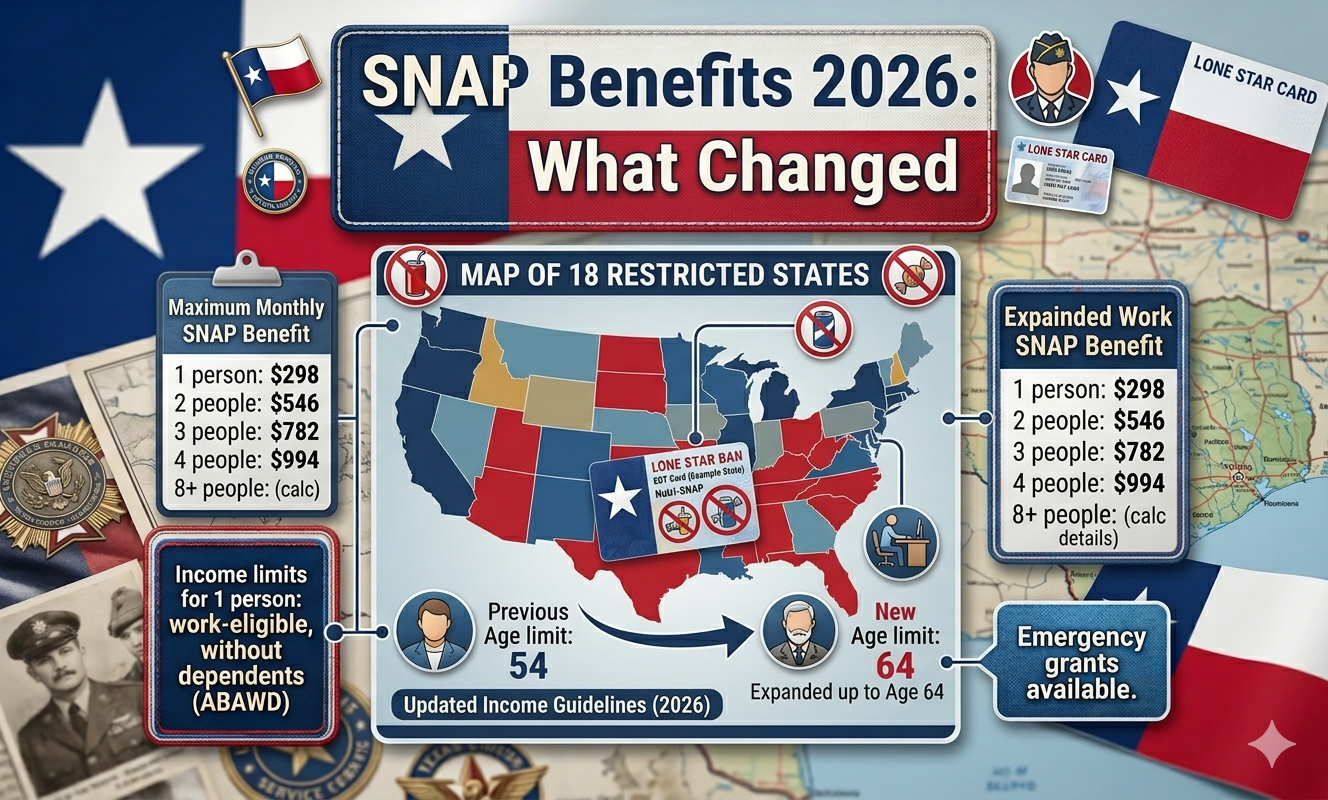
Work requirements expanded (March 2026): Able-bodied adults 18–64 must document 80 hours/month of work, training, volunteering, or job search. The age limit increased from 55 to 64. Exemptions exist for parents with children under 14, pregnant women, veterans, homeless individuals, and those with disabilities.
Benefit increase (October 2025): Maximum allotments increased with cost-of-living adjustments. A family of 4 can receive up to $994/month.
Asset limits unchanged: $3,000 for most households; $4,750 for households with elderly/disabled members.
Standard deduction increased: $209 for 1–3 persons; $223 for 4; $261 for 5; $299 for 6+.
Online access expanded: 46 states now accept online applications; 33 allow online recertification.
Minimum benefit: $24/month for 1–2 person households in most states.
Frequently Asked Questions
1. Can I qualify for EBT if I have a job?
Yes. Many SNAP recipients work. If your gross monthly income is at or below 130% of the federal poverty level, you may qualify. For a family of 4, that means earning under $3,483/month. You may also qualify if you work part-time or have variable hours.
2. What is the income limit for a family of 4?
For FY2026, a family of 4 must have gross monthly income at or below $3,483 (130% FPL) and net monthly income at or below $2,680 (100% FPL). If your state uses Broad-Based Categorical Eligibility, the gross limit may be higher (165%, 185%, or 200% FPL).
3. Can I get SNAP if I’m a college student?
Full-time college students (enrolled at least half-time) generally do not qualify unless they meet an exemption: working 20+ hours/week, participating in work-study, receiving TANF, caring for a child under 6, or being a single parent enrolled full-time. Check your state’s student rules.
4. Do I need to be a U.S. citizen to get SNAP?
No. Lawful Permanent Residents (Green Card holders) with 40 qualifying work quarters, Cuban/Haitian entrants, COFA citizens, and certain military-connected immigrants qualify. Undocumented immigrants do not qualify.
Standard processing takes up to 30 days. If you qualify for expedited benefits (very low income and resources), you can receive benefits within 7 days. Online applications are typically processed faster.
6. What can I buy with EBT?
You can buy food for home preparation: fruits, vegetables, meat, poultry, fish, dairy, bread, cereals, snacks, and seeds/plants that produce food. You cannot buy alcohol, tobacco, pet food, household supplies, hot prepared foods, or non-food items.
7. Can I get SNAP if I’m homeless?
Yes. Homeless individuals can qualify as their own household. You can use a shelter address, a friend’s address, or a general delivery address. You may also qualify for expedited benefits.
8. What happens if I miss my recertification deadline?
If you miss your recertification deadline, your benefits will stop. You may need to reapply as a new applicant. Contact your state agency immediately — some states allow a grace period.
9. Can I get SNAP if I’m disabled?
Yes. If you receive SSI or SSDI, you may automatically meet SNAP income requirements in some states. You only need to meet the net income test (not gross). You may also qualify for a higher asset limit ($4,750) and medical expense deductions.
10. How much can I get in SNAP benefits?
Maximum monthly benefits for FY2026: $298 (1 person), $546 (2), $785 (3), $994 (4), $1,183 (5), $1,421 (6), $1,571 (7), $1,789 (8). Your actual benefit depends on income, expenses, and household size. Minimum benefit is $24 for most 1–2 person households.
11. Do I have to meet work requirements for SNAP?
Adults 18–64 must work, volunteer, or participate in job training for 80 hours/month unless exempt. Exemptions include: children under 14, pregnant, veterans, homeless, disabled, receiving unemployment, or participating in drug/alcohol treatment.
12. Can I get SNAP if I have savings?
Most states allow up to $3,000 in countable assets ($4,750 if someone is 60+ or disabled). Many states have eliminated asset tests entirely through BBCE. Your home and one vehicle per adult usually don’t count.
13. What is the difference between SNAP and EBT?
SNAP is the program. EBT is the card you use to access benefits. SNAP benefits load onto an EBT card, which works like a debit card at grocery stores and farmers markets.
14. Can I use EBT online?
Yes. Many major retailers accept EBT online, including Amazon, Walmart, and Instacart (in participating states). Check your state’s approved online retailers.
15. What if my application is denied?
You have 90 days to request a fair hearing. Read your denial notice, request a hearing in writing or by phone, and explain why you disagree. You can represent yourself or bring help.
Key Takeaways
SNAP eligibility is based on income, household size, citizenship/immigration status, assets, and work requirements.
Gross income limit is 130% FPL ($1,696/month for 1 person; $3,483/month for 4). Net income limit is 100% FPL.
42 states use BBCE, raising income limits to 165%, 185%, or 200% FPL for many households.
Asset limits: $3,000 for most households; $4,750 if someone is 60+ or disabled. Many states have no asset test.
Maximum benefits range from $298/month (1 person) to $994/month (4 persons). Minimum is $24 for most small households.
Work requirements: Adults 18–64 must work, train, or volunteer 80 hours/month unless exempt.
Immigration: LPRs, Cuban/Haitian entrants, COFA citizens, and certain military-connected immigrants qualify. Undocumented immigrants do not.
Apply online in 46 states. Standard processing is 30 days; expedited benefits within 7 days.
Recertify every 12 months (24 months for elderly/disabled households). Missing your deadline means losing benefits.
Appeal within 90 days if denied. You have the right to a fair hearing.
Related Government Benefits
If you qualify for SNAP, you may also qualify for these programs:
Medicaid — Free or low-cost health insurance for low-income individuals and families. Apply through your state Medicaid agency or HealthCare.gov.
TANF (Temporary Assistance for Needy Families) — Cash assistance for families with children. Provides monthly cash payments and job training. Apply through your state human services agency.
SSI (Supplemental Security Income) — Monthly cash payments for aged, blind, and disabled individuals with limited income and resources. Apply through SSA.gov.
LIHEAP (Low Income Home Energy Assistance Program) — Helps pay heating and cooling bills. Apply through your state LIHEAP office.
Section 8 Housing Choice Voucher — Rental assistance that pays a portion of your rent. Apply through your local public housing agency (HUD.gov).
WIC (Women, Infants, and Children) — Nutrition assistance for pregnant women, new mothers, and children under 5. Provides food benefits, breastfeeding support, and nutrition education.
Child Tax Credit — Up to $2,000 per qualifying child. File a tax return to claim even if you don’t owe taxes. Visit IRS.gov.
Earned Income Tax Credit (EITC) — Tax credit for low- to moderate-income workers. Worth up to $7,430 for families with 3+ children. File a tax return to claim.