How to Apply for Food Stamps in Texas (SNAP): Complete Guide
Quick Answer
You can apply for food stamps (SNAP) in Texas online at YourTexasBenefits.com, by phone at 2-1-1 (option 2), or in person at a local HHSC benefits office. Eligibility depends on household size, income, citizenship status, and work requirements. Most households receive benefits within 30 days of application, with approval loaded monthly onto a Lone Star Card for grocery purchases.
Low-income households meeting income and asset limits
Income Limits
Varies by household size (see chart below)
Monthly Benefit
Up to $298 for 1 person; $994 for family of 4
Application
Online, phone, in-person, or mail/fax
Processing Time
Standard: 30 days; Expedited: 5 days for emergencies
Renewal
Typically every 6 months; 36 months for elderly/disabled
Available States
Texas only
Last Updated
February 2026
What Is This Program?
The Supplemental Nutrition Assistance Program (SNAP)—formerly called food stamps—is a federal program administered in Texas by the Texas Health and Human Services Commission (HHSC) . SNAP provides monthly financial assistance to help low-income households purchase nutritious food.
How it works in Texas: Approved households receive monthly benefits on a Lone Star Card, which functions like a debit card. You can use it at grocery stores, supermarkets, farmers’ markets, and other authorized retailers by swiping the card and entering your PIN .
SNAP benefits help stretch your budget. The money you save on groceries can go toward other essentials like rent, utilities, and medical bills . In Texas, approximately 3.47 million people receive SNAP benefits, making it a critical resource for food-insecure families .
Who Qualifies for SNAP in Texas?
Who DOES Qualify:
Families with low income and limited resources
Seniors (age 60+) and people with disabilities (may have simplified application and longer benefit periods)
Working individuals and families—including those who are unemployed or employed
Veterans, active military personnel, and their families
Legal immigrants who meet specific requirements
Individuals experiencing homelessness
Pregnant women, disabled individuals, and caregivers of children under 6 (exempt from work rules)
Who Does NOT Qualify:
U.S. citizens and qualified non-citizens are eligible, but undocumented immigrants generally are not
Individuals with household resources exceeding $5,000 (excluding home and certain vehicles)
Able-bodied adults without dependents (ABAWDs) who don’t meet work requirements
College students, with limited exceptions (see Real-Life Situations below)
Individuals who voluntarily quit a job without good cause
People who fail to provide required documentation or cooperate with eligibility interviews
Common Exceptions:
Households receiving Supplemental Security Income (SSI) or Temporary Assistance for Needy Families (TANF) may be automatically income-eligible
Texas Simplified Application Project (TSAP) provides simplified applications and 3-year benefit periods for households where all members are elderly (60+) or disabled
Homeless individuals can qualify even without a permanent address
Income Limits for SNAP in Texas
Texas uses monthly household income limits to determine eligibility. The chart below shows current maximum income limits by household size :
Household Size
Maximum Monthly Gross Income
1
$2,152
2
$2,909
3
$3,665
4
$4,421
5
$5,177
6
$5,934
7
$6,690
8
$7,446
Each Additional Person
+$757
Important: These limits are for gross income (income before taxes and deductions). For most households, net income (income after allowed deductions) must also fall below program limits .
Income Deductions that can lower your countable income include :
Housing costs (rent/mortgage and utilities)
Child support payments
Childcare expenses
Monthly medical expenses over $35 for disabled or elderly (60+) individuals
Dependent care costs
Income Examples:
Family of 4 earning $42,000/year ($3,500/month): Gross income is $3,500, which is below the $4,421 monthly limit. After deductions for rent and childcare, net income may be below the limit. This family likely qualifies for approximately $994/month .
Senior receiving SSI: If you receive SSI, you may be automatically eligible for SNAP. Texas operates a Modified Combined Application Project (CAP) with the Social Security Administration to simplify applications for SSI recipients .
Disabled worker: Disabled individuals may have higher income allowances and medical deductions . They are also exempt from work requirements .
Asset Limits
Texas has resource limits for SNAP eligibility:
Asset Type
Limit
Cash, bank accounts, and other liquid assets
$5,000 total
Vehicles
Primary vehicle excluded; additional vehicles count if value exceeds $22,000
Home
Excluded from resource calculation
Who may be exempt from asset limits?
Households receiving SSI or TANF may not need to meet asset tests
Elderly (60+) and disabled households may have different resource rules
Work Requirements: What You Need to Know
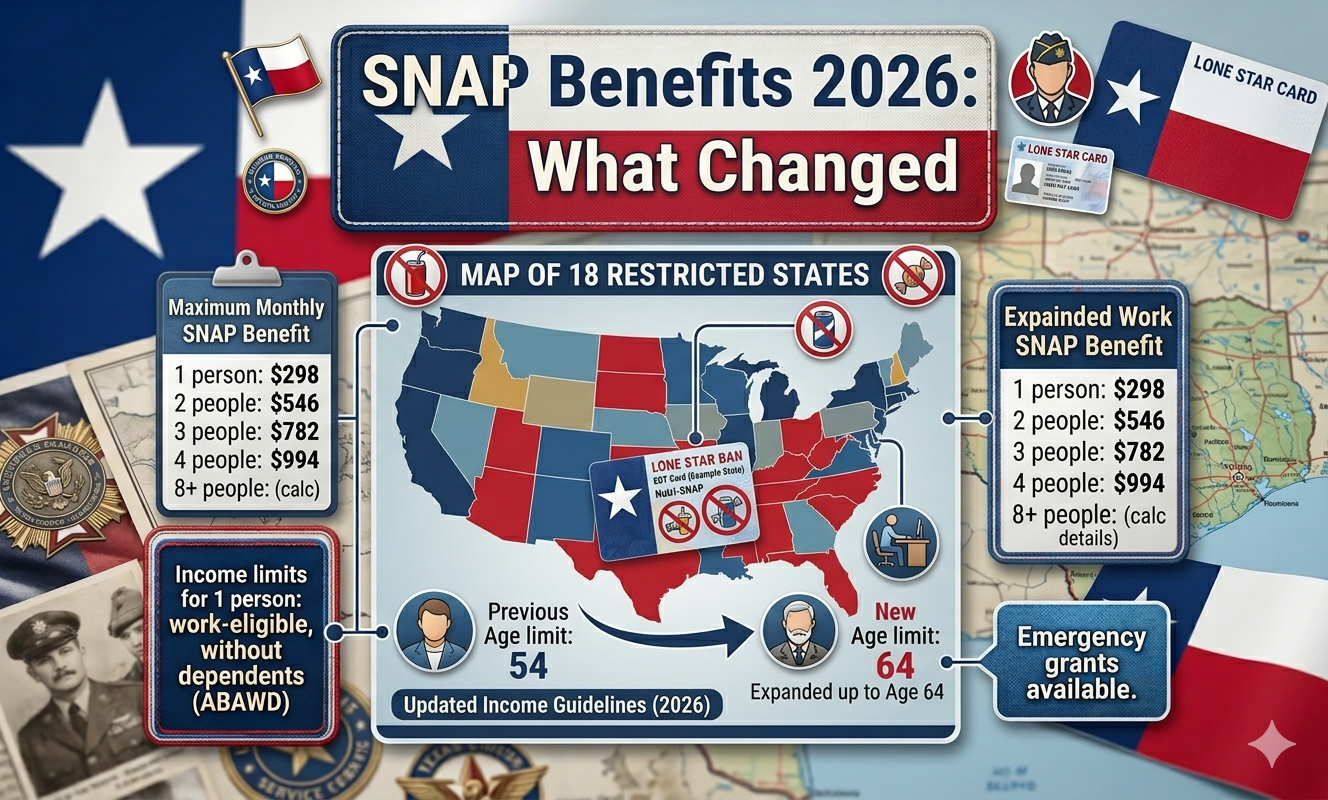
Important update as of November 1, 2025: Texas expanded SNAP work requirements. The age range for those required to work increased to 18–64 (previously 18–54). More groups now must document work hours, including veterans, homeless individuals, and parents whose children are all ages 14–17 .
Who Must Work:
Most adults ages 16–59 must work, look for work, or participate in an approved work or training program
Most adults ages 18–49 without children can receive SNAP for only 3 months in a 3-year period unless working at least 20 hours per week
Work Hour Requirements:
Required to work at least 20 hours per week or 80 hours per month
Must document and submit work hours to HHSC for verification
Qualifying Work Activities Include :
Paid employment
Unpaid volunteer work
Receiving goods/services in lieu of payment
Participation in SNAP Employment and Training
Workforce Innovation and Opportunity Act (WIOA) programs
Texas Workforce Commission (TWC) work programs
Who is EXEMPT from Work Requirements:
Pregnant women
Individuals with physical or mental disabilities
Adults 65 and older
Children under 17
Caregivers of children under 6
Individuals caring for a disabled dependent
Full-time students enrolled at least half-time (with exceptions)
Individuals participating in substance abuse treatment programs
Who is NO LONGER Exempt (as of November 2025):
Veterans (unless disabled)
Homeless individuals (unless otherwise exempt)
Parents with children all between ages 14–17
Young adults aging out of foster care
Household Requirements
What defines a SNAP household? A household includes people who live together AND buy and prepare food together .
Common Household Scenarios:
Married couples and children: Typically counted as one household
Roommates: May apply separately if they buy and prepare food separately
Elderly or disabled individuals: May be eligible for simplified application processes
Citizenship and Immigration Rules
Who Qualifies:
U.S. citizens
Legal permanent residents (green card holders)
Qualified non-citizens who meet specific requirements
Refugees, asylees, and certain other humanitarian entrants (usually for the first 7 years after entry)
Who Does NOT Qualify:
Undocumented immigrants
Non-citizens without qualified immigration status
Some immigrants with temporary protected status or student visas
Note: You must provide proof of citizenship or eligible immigration status for all household members applying for benefits .
Required Documents
Gathering documents before you apply can speed up the process significantly. You don’t need every document to start an application—you can submit missing information later .
Dallas College food pantries also provide application assistance
Option 4: Apply by Mail or Fax
Download a paper application from YourTexasBenefits.com, complete it, and mail or fax it to HHSC .
Mailing Address: Texas Health and Human Services Commission PO Box 149024 Austin, TX 78714-9968
Get Application Assistance
Feeding Texas network food banks: Provide application assistance
Dallas College: Virtual assistance through North Texas Food Bank
Local community organizations: Many partner with HHSC to help with applications
Application Processing Time
Application Type
Processing Time
Details
Standard
30–45 days
Most applications
Expedited (Emergency)
5 days
For emergency situations
Expedited SNAP Benefits
You may qualify for emergency SNAP benefits within 5 days if you meet ANY of these criteria :
Household has resources of $100 or less AND monthly income under $150
Household resources and income are less than rent/mortgage and utility expenses
Household includes a migrant or seasonal farm worker with $100 or less in resources and very little income
Apply for expedited benefits in person at an HHSC office or by calling 2-1-1.
After You Apply:
Phone Interview: A caseworker will typically contact you to verify household details, income, and expenses
Document Submission: Submit any requested documents
Decision: HHSC sends approval or denial notice with explanation
Benefit Issuance: If approved, benefits are loaded monthly onto your Lone Star Card
HHSC Caller ID: For application questions, HHSC usually calls from (736) 867-7700 .
Monthly Benefit Amounts
Your exact SNAP benefit depends on household size, income, and allowable deductions. The chart below shows maximum monthly benefits (for households with no income) :
Household Size
Maximum Monthly SNAP Benefit
1
$298
2
$546
3
$785
4
$994
5
$1,183
6
$1,421
7
$1,571
8
$1,789
Each Additional Person
+$218
Average Benefit: Most households receive less than the maximum, as benefits are calculated based on net income after deductions.
Benefit Calculation: SNAP benefits are calculated using a formula: Maximum benefit for household size minus (net income × 0.30). This means as your income increases, benefits gradually decrease.
Payment Schedule
Benefits are loaded onto your Lone Star Card on the same day each month based on your case number. Benefits do not roll over from month to month—use them within the benefit month.
Using Your Lone Star Card:
Use it like a credit card at authorized retailers
Enter your PIN at checkout
Check balance online, by phone, or on receipts
Works at grocery stores, supermarkets, and farmers’ markets
Renewal Process
SNAP benefits are not permanent—you must renew (recertify) to continue receiving benefits.
Renewal Type
Benefit Period
Requirements
Standard
6 months
Most households
Elderly/Disabled Households
36 months
Through Texas Simplified Application Project (TSAP)
Short-Term
1–3 months
Some households with special circumstances
How to Renew:
Watch for renewal notice: HHSC sends a letter when it’s time to recertify
Submit renewal application: Online, by phone, mail, or in person
Provide updated documentation: Submit proof of any changes in income, expenses, or household members
Complete interview: Required for most renewals unless exempt (TSAP households may waive this)
Simplified Renewal for Elderly/Disabled: Under Texas law, elderly and disabled households may skip the interview and use a simplified application . They must still submit a change reporting form every 12 months and report income increases .
Reasons Applications Are Denied
Common reasons for SNAP denial include :
Income Issues
Household income exceeds program limits
Failure to verify income with required documents
Documentation Problems
Missing proof of identity, income, or residency
Failure to submit required documents within deadlines
Application Issues
Incomplete application
Not cooperating with the interview or providing requested information
Work Requirements
ABAWDs not meeting work requirements
Failure to document work hours when required
Citizenship or Immigration Status
Not meeting citizenship or immigration requirements for all household members
Failure to provide required immigration documentation
Procedural Mistakes
Missing application deadlines
Not reporting changes in household composition or income
Appeals Process
If your application is denied or your benefits are reduced, you have the right to appeal.
How to Appeal:
Read the denial letter: It explains the reason for denial and your appeal rights
Request a fair hearing: Contact HHSC within the timeframe specified in your denial notice
Provide supporting documentation: Submit evidence supporting your case
Attend the hearing: Present your case to an administrative law judge
Deadlines:
You typically have 90 days from the date of the denial notice to request a hearing
Benefits may continue during the appeal process if you request a hearing within 10 days of the notice
Need help with an appeal? Contact Texas Legal Aid or Texas Law Help for free legal assistance .
Common Mistakes to Avoid
Avoid these common pitfalls that delay applications or reduce benefits:
Mistake
How to Avoid
Not applying because you think you won’t qualify
Apply anyway—many households that think they won’t qualify actually do. Let HHSC determine eligibility
Missing documents
Gather documents before starting your application. Missing documents delay processing
Not reporting changes
Report changes in income, household size, or address immediately
Failing to document work hours
New work requirements require documentation. Log and submit hours to HHSC
Skipping the interview
Complete the required phone interview to avoid denial
Not updating renewal information
Renew on time and provide updated documentation
Assuming you’re exempt from work rules
Verify if you’re truly exempt. Veterans and homeless individuals are no longer automatically exempt
Not using application assistance
Food banks and community organizations can help with applications
Recent Changes (2025–2026)
Work Requirement Expansion (Effective November 1, 2025)
Key changes impacting Texas SNAP recipients:
Change
Details
Age range expanded
Work requirements now apply to ages 18–64 (was 18–54)
New mandatory groups
Veterans, homeless individuals, parents with children 14–17, foster youth aging out
Work hours required
20 hours/week or 80 hours/month
Documentation required
Must log and submit work hours to HHSC
Exemptions remain
Pregnant women, disabled, adults 65+, caregivers of children under 6
What this means for you: If you’re in the newly affected group (ages 55–64, veteran, homeless, etc.), you must now document work activity or risk losing benefits. Apply for exemptions if you qualify .
Replacement Benefits for Lost Food: Following winter weather, HHSC extended deadlines for replacement benefits for food lost or destroyed. Submit requests at local HHSC offices .
Related Government Benefits
If you’re applying for SNAP, you may also qualify for these programs:
1. TANF (Temporary Assistance for Needy Families)
Cash assistance for low-income families with children. Administered by HHSC.
2. Medicaid/CHIP
Free or low-cost health insurance for children, pregnant women, and low-income adults. Apply through YourTexasBenefits.com.
3. WIC (Special Supplemental Nutrition Program for Women, Infants, and Children)
Nutrition support for pregnant women, new mothers, and children under 5. Operates through the Texas Department of State Health Services.
4. LIHEAP (Low Income Home Energy Assistance Program)
Energy bill assistance and weatherization services. Administered through local Community Action Agencies.
5. Section 8 Housing Choice Voucher
Rental assistance for low-income households. Administered by local housing authorities and HUD.
6. SSI (Supplemental Security Income)
Monthly income for disabled, blind, or elderly individuals with limited resources. Administered by Social Security .
7. SSDI (Social Security Disability Insurance)
Disability benefits for disabled workers and their families. Social Security .
8. Child Tax Credit / Earned Income Tax Credit
Federal tax credits for low- to moderate-income working families. Claim on annual tax returns.
9. TANF (Temporary Assistance for Needy Families)
Cash assistance for low-income families with children. Administered by HHSC .
10. Free Lunch Program / School Breakfast Program
Free or reduced-price meals at school for children in low-income families. Check with your child’s school district.
Frequently Asked Questions
1. How do I apply for food stamps in Texas?
Apply online at YourTexasBenefits.com, by phone at 2-1-1 (option 2), in person at an HHSC office, or by mail/fax .
2. What is the income limit for food stamps in Texas?
Income limits depend on household size. A single person can earn up to $2,152/month; a family of 4 up to $4,421/month. These limits change annually .
3. How long does it take to get approved for SNAP in Texas?
Standard applications are processed within 30–45 days. Emergency applications (expedited SNAP) are processed within 5 days if you meet criteria .
4. What is the Lone Star Card?
The Lone Star Card is Texas’s EBT (Electronic Benefit Transfer) card. SNAP benefits are loaded monthly onto this card, which you use like a debit card at grocery stores .
Yes. Homeless individuals can qualify for SNAP. Your homeless status does not exempt you from work requirements unless you have a disability or other exemption .
6. Can college students get SNAP in Texas?
College students are generally ineligible unless they meet specific exemptions: work 20+ hours/week, have a child under 6, receive TANF or work-study, or have a disability .
7. What documents do I need to apply for SNAP?
You need proof of identity, income, Texas residency, citizenship/immigration status, and expenses. You don’t need all documents to start; you can submit later .
8. Do I have to work to get SNAP?
Most adults ages 18–64 must work, look for work, or participate in work training at least 20 hours/week unless exempt. Exemptions include disability, pregnancy, caring for young children, and age 65+ .
9. How much will I get for SNAP in Texas?
Maximum benefits range from $298 (1 person) to $1,789 (8 people). Your actual benefit depends on household income and deductions .
10. How often do I need to renew SNAP benefits?
Most households must renew every 6 months. Elderly and disabled households may qualify for 36-month renewal through TSAP .
11. Can I get expedited SNAP benefits?
Yes, within 5 days if you have $100 or less in resources and income under $150, or if your resources and income are less than your rent and utilities .
12. What happens if my SNAP application is denied?
You can appeal the decision. Request a fair hearing within the timeframe stated in your denial letter. You can also reapply if your circumstances change.
13. Are immigrants eligible for SNAP?
Qualified non-citizens (lawful permanent residents, refugees, asylees, etc.) may be eligible. Undocumented immigrants are not eligible .
14. Does SNAP count toward public charge?
SNAP benefits generally are not considered in public charge determinations for most immigrants, but consult with an immigration attorney for your specific situation.
15. Can I use my Lone Star Card outside Texas?
No. SNAP benefits are issued by state, but you can use your Texas Lone Star Card in other states that accept SNAP .
The Supplemental Nutrition Assistance Program (SNAP) in Texas serves as a critical safety net for low-income families, enabling them to access nutritious food. The program, federally funded but administered by state agencies, aims to alleviate food insecurity among vulnerable populations across the state. Recognizing that nutritious food plays a vital role in maintaining health and well-being, SNAP helps families stretch their food budgets, ensuring they can afford healthier options.
Eligibility for SNAP in Texas is determined by several factors, primarily focusing on household income, size, and certain expenses. Generally, households must have a gross monthly income that does not exceed 130% of the federal poverty level to qualify. Additionally, assets such as cash, bank accounts, and certain property are taken into account. Specific standards for eligibility cater to families, individuals, the elderly, and people with disabilities, ensuring that support is directed to those who need it most.
The benefits provided by SNAP can significantly improve the quality of life for recipients. Each household receives an Electronic Benefit Transfer (EBT) card loaded with monthly allowances, which can be used at authorized retailers to purchase eligible food items. The program promotes better eating habits and is beneficial not only for individual health but for community welfare at large. By facilitating access to essential food items, SNAP plays a crucial role in combating hunger and fostering overall food security in Texas.
Household size is another important factor when applying for SNAP. Texas categorizes households based on the number of people living together and their financial contributions. A household generally includes individuals who purchase and prepare food together. Size directly impacts the income limits, as larger households have higher income thresholds. Therefore, an accurate account of all members must be included during the eligibility assessment.
Citizenship status also plays a critical role in SNAP eligibility. To qualify, applicants must be U.S. citizens or meet specific legal residency requirements. Generally, qualified aliens may also receive benefits if they have been lawfully residing in the United States for at least five years or if they meet certain exceptions, such as being military members or children.
Texas further distinguishes between applicants based on different categories, specifically families, the elderly, and individuals with disabilities. Each category may be eligible for varied assistance levels and resources. Understanding these distinctions can aid applicants in determining the best course of action for their specific circumstances.
Gathering Necessary Documents
When applying for the Supplemental Nutrition Assistance Program (SNAP) in Texas, also known as food stamps, it is essential to gather all required documents to support your application. This process involves collecting identification, proof of income, and residency documentation, all of which are critical to ensure a smooth application experience.
First and foremost, individuals must provide valid identification. Acceptable forms include a Texas driver’s license, state identification card, or federal identification. These documents not only verify your identity but also establish your citizenship, which is a requisite for SNAP eligibility.
Next, proof of income is required, aiming to assess your financial situation accurately. This can entail recent pay stubs, tax returns, or benefit statements. For those who receive any type of public assistance or have irregular income, it is advisable to include documents that detail monthly income fluctuations. The total household income will be evaluated against SNAP guidelines to determine benefits.
Residency documentation is another critical aspect of the application. Applicants are required to submit proof of their residence in Texas, which can be fulfilled via a utility bill, bank statement, or lease agreement. This helps establish your connection to the state and your eligibility to receive food assistance.
Lastly, applicants should be aware of the verification process involved in SNAP applications. The Texas Health and Human Services Commission may request additional information or clarification during the processing phase. Maintaining organized and accessible documents can greatly facilitate this process, minimizing delays and ensuring that your application is reviewed in a timely manner.
Application Methods: Online, In-Person, and By Mail
Applying for Supplemental Nutrition Assistance Program (SNAP) benefits, commonly referred to as food stamps, in Texas can be done through several convenient methods. Understanding these methods will help applicants choose the one that best fits their circumstances. The primary options include online applications, in-person submissions, and those sent by mail.
To apply online, individuals can visit the Texas Benefits website. This user-friendly portal allows applicants to access the SNAP application form, which they can complete and submit electronically. Users must create an account, providing some personal information such as their Social Security number and date of birth to start the process. The online method is convenient, as it enables users to complete the application at their own pace and from the comfort of their home. Additionally, the system allows applicants to track the status of their applications and receive notifications about any updates or required actions.
For those preferring to apply in-person, local health and human services offices are available throughout Texas. Applicants can find their nearest office through the Texas Health and Human Services (HHSC) website. When attending in person, individuals should bring along necessary documentation, including identification and proof of income, to expedite the process. During the visit, caseworkers will assist in filling out the application and provide guidance on the next steps, ensuring that applicants fully understand the requirements.
Finally, individuals who wish to submit a paper application can do so by downloading and printing the application form from the Texas Benefits website. Once completed, the form can be mailed to the appropriate local HHSC office. It is crucial to check the mailing address and to ensure that all required documents are included with the application to avoid delays in processing.
To begin, applicants must create an account on the Texas Benefits website. This procedure is straightforward; users need to visit the site and select the option for account creation. Necessary information such as name, email address, and a secure password will be required. It is crucial to remember the credentials for future logins, as these will be needed to check application status or make subsequent changes.
Once the account is set up, applicants can proceed to fill out the application form. The application consists of several sections that require detailed personal information, including household size, income, expenses, and resources. Accuracy is vital at this stage to ensure eligibility. Applicants should have supporting documents ready, such as proof of income or identification, to facilitate the application process.
After filling out the form, applicants should review their entries thoroughly before submitting. A common pitfall is the omission of vital information, which can lead to delays or rejection of the application. To avoid these issues, double-checking all provided details is essential. After confirming that all information is accurately filled, applicants can submit their application electronically. A confirmation number will be generated, which can be used to track the application status.
Additionally, it is advisable to consult the Texas Benefits website for guidance on common errors encountered during the application process. Being informed can significantly enhance the likelihood of a successful application. By following these steps and avoiding common mistakes, applicants can navigate the online process smoothly, ensuring they receive the benefits for which they are eligible.
What to Expect After Submission
Once you have submitted your application for food stamps in Texas through the Supplemental Nutrition Assistance Program (SNAP), there are several important steps in the process that you should be aware of. Typically, the Texas Health and Human Services Commission (HHSC) processes applications within 30 days. However, if you are experiencing a food emergency, it is crucial to inform the HHSC, as expedited benefits may be available to eligible applicants within 7 days.
Following the submission, you may receive a notice detailing your application’s receipt and the specific timeline for processing. It is advisable to keep this document handy for your reference. In some instances, the HHSC may contact you for a follow-up interview or request additional information to verify your eligibility. This communication could occur via phone, email, or mail. It is essential to respond promptly to any inquiries to avoid delays in the processing of your application. Ensure your contact information is accurate upon submission to facilitate this process.
In the event that your application is denied, you will receive a written notification explaining the reasons for the denial. You have the right to appeal this decision if you believe it to be unjustified. The appeal process requires you to request a hearing within a specified timeframe, which is typically 90 days from the date you receive the denial notice. It is beneficial to gather any supporting documentation that could substantiate your claim during the appeals process, as this may strengthen your case.
Ultimately, understanding the steps that follow your application submission can help ensure that you are prepared and informed as you navigate the SNAP application process in Texas. It is vital to remain proactive in following up with any required documentation or interviews to facilitate a timely resolution.
Managing Your SNAP Benefits
Once you have been approved for the Supplemental Nutrition Assistance Program (SNAP), it is essential to know how to effectively manage your benefits. First and foremost, recipients are issued an Electronic Benefits Transfer (EBT) card, which functions similarly to a debit card. This card can be used to purchase eligible food items at authorized grocery stores and farmers’ markets across Texas.
To make the most out of your SNAP benefits, keeping track of your EBT card balance is crucial. You can check your balance by logging into your account online, using the EBT app, or calling the customer service number printed on the back of your card. Regularly monitoring your balance helps you plan your grocery shopping more effectively and prevents running out of funds before the next benefit cycle begins.
Changes in personal circumstances, such as income fluctuations, household composition alterations, or changes in living costs, need to be reported to the Texas Health and Human Services Commission (HHSC). Reporting these changes ensures that you retain the appropriate benefit level and continued eligibility. You can easily report changes online, by phone, or in person at local HHSC offices.
When approaching the end of your certification period, it is important to renew your benefits to maintain continuous support. This process can often be completed online through the HHSC portal, and early submission is advised to avoid a lapse in your benefits.
To maximize your SNAP benefits, consider budgeting effectively for groceries. Planning meals, shopping with a list, and utilizing sales and discounts can stretch your monthly benefits further. Additionally, seeking out community resources, such as food pantries and local nutrition programs, can supplement your groceries and enhance your ability to access nutritious food.
Common Questions and Troubleshooting
When applying for food stamps in Texas, commonly known as the Supplemental Nutrition Assistance Program (SNAP), applicants may have various questions and face challenges throughout the process. Addressing these inquiries can significantly ease the journey.
One frequent issue occurs during the online application process. Applicants often report technical difficulties, such as website errors or a failure to upload necessary documents. In these cases, it is advisable to clear the browser cache or try a different browser. If problems persist, contacting the Texas Health and Human Services (HHSC) Office through their official customer service line can provide guidance. Their representatives are equipped to assist with technical issues and can offer alternative application submission methods.
Another common concern pertains to eligibility misunderstandings. Many applicants are unsure if their income or household size qualifies for assistance. The eligibility criteria for SNAP can be complex and depend on several factors, including household income, expenses, and size. The HHSC website provides a detailed overview of these criteria, which can help applicants better understand their situation and eligibility. It may also be beneficial to use the pre-screening tool available on their site to gauge potential eligibility.
For those facing additional challenges or with specific queries, numerous resources are available. Community organizations often provide support and can help navigate the SNAP application process. If individuals require further assistance regarding their application status or need to report changes, reaching out directly to the relevant HHSC office can ensure that proper measures are taken and queries are resolved efficiently.
Having access to reliable information and support resources is crucial for a smooth application process for food stamps in Texas. Addressing potential issues proactively can help applicants effectively receive the assistance they need.
Resources and Support for Applicants
Navigating the application process for the Supplemental Nutrition Assistance Program (SNAP) in Texas can be daunting, but a plethora of resources are available to assist applicants in their journey. To begin with, the Texas Health and Human Services (HHS) website serves as the primary source of information regarding SNAP, offering guidelines on eligibility, application procedures, and necessary documentation. This website is pivotal for understanding the specifics of the benefits available and how to access them.
In addition to the official HHS resources, applicants may reach out to local food assistance programs, many of which operate throughout Texas. Organizations such as the Texas Food Bank Network provide support not just in food distribution, but also in assisting individuals with the SNAP application process. These local food banks often have dedicated staff members who can provide hands-on help, ensuring that applicants submit complete and accurate applications.
Advocacy organizations play a critical role in providing support to individuals seeking assistance. Groups like the Texas Hunger Initiative work to increase awareness of food resources and advocate for policies that support low-income Texans. They often host educational workshops and outreach events designed to empower applicants with the knowledge and tools they need to successfully navigate the SNAP application process.
Moreover, hotlines are available for those who require immediate assistance or have specific inquiries. The Texas HHS SNAP Information line is a valuable resource for anyone needing clarification on application status, benefit amounts, or general program details. This 24-hour hotline ensures that assistance is accessible at any time, reinforcing the commitment to support eligible individuals.
In conclusion, with a range of resources and supportive services available, applicants can confidently seek the assistance they need to access vital food resources through SNAP in Texas. By utilizing the information provided by official channels, local organizations, and hotlines, individuals can ensure that they have all necessary tools to apply successfully and obtain assistance.