EBT Recertification: Complete Guide to Renewing SNAP Benefits in 2026
EBT recertification is the process of renewing your eligibility for SNAP food benefits before your current certification period ends. Most households must recertify every 6, 12, or 24 months, depending on household circumstances and state rules. File your renewal form by the 15th day of your last certification month to keep benefits uninterrupted. A phone or in-person interview is generally required at least once every 12 months. If you miss the deadline, benefits stop, and reinstatement depends on how quickly you act.
USDA Food and Nutrition Service (FNS) sets federal rules; state SNAP agencies administer recertification
Eligibility
Current SNAP households whose certification period is ending; eligibility must be reestablished through a renewal application, interview (if required), and verification
Income Limits
Same income tests that applied at initial certification: gross and net income limits based on household size and state rules
Monthly Benefit
Benefits continue at the approved level after recertification if the household remains eligible; if income or household size changed, the benefit amount is recalculated
Application
State online portals; by mail; by phone; in person at local SNAP offices; some states accept fax
Processing Time
Recertification is considered timely when the household has access to benefits by its normal issuance date; standard processing is 30 days for most households
Renewal
Every 6, 12, or 24 months, depending on state policy and household circumstances; 36 months for ESAP households in many states
Available States
All 50 states, DC, Guam, and the Virgin Islands, with state-specific rules
Last Updated
October 2026
What Is EBT Recertification?
EBT recertification is the full redetermination of SNAP eligibility that happens at the end of a household’s certification period. It is not the same as an interim report. During recertification, the state re-verifies income, household composition, expenses, resources, and immigration status to decide whether the household remains eligible and, if so, at what benefit level.
The certification period is the amount of time a household is authorized to receive SNAP benefits. When that period ends, benefits do not continue automatically. The household must file a renewal application, complete an interview if required, and provide verification. If all steps are completed before the certification period ends, benefits continue without a gap. If any step is missed, benefits stop on the last day of the certification period, and restoration depends on how many days have passed and what the household does next.
Who Must Recertify?
Every SNAP household must recertify to continue receiving benefits beyond its current certification period. There is no automatic renewal for standard SNAP households. Even households whose circumstances have not changed must complete the recertification process, because eligibility rules, income limits, and benefit amounts can change between certification periods.
Who does NOT need a standard recertification
ESAP households (all adults are 60 or older or have a disability, with no earned income) may qualify for 36-month certification periods and a waived recertification interview in states that operate the Elderly Simplified Application Project. They still must recertify, but the process is simplified and less frequent.
Households that voluntarily leave SNAP do not need to recertify, but they must reapply if they want benefits again later.
Common exceptions and special situations
Households certified for 24 months because all adult members are elderly or disabled, or because they live on a reservation and submit monthly reports, are not required to have a face-to-face interview during the certification period. Their interview requirement is handled at recertification under the applicable rules.
Households with unstable circumstances may receive shorter certification periods—4, 5, or 6 months—which means they recertify more often. Ohio assigns a 6-month certification period to households that include an able-bodied adult without dependents.
Certification Periods: How Long Until You Recertify?
Certification periods for SNAP vary by state policy and household circumstances. There is no single federal certification length. The most common periods are 12 months for standard households, 24 months for households in which all adults are elderly or disabled, and 36 months for ESAP households in states that have adopted the project.
Typical certification periods by household type:
Household type
Common certification period
Recertification frequency
Standard household with earned income
6 to 12 months
Every 6–12 months
Household with unstable circumstances or an able-bodied adult without dependents (ABAWD)
4 to 6 months
Every 4–6 months
Household in which all adults are elderly or disabled, with no earned income
24 to 36 months
Every 24–36 months
ESAP household (all adults 60+ or disabled, no earned income)
36 months
Every 36 months, interview often waived
Ohio’s rules illustrate the range: a standard assistance group receives 12 months, an elderly/disabled group with no earned income receives 36 months, and an assistance group with unstable circumstances or an able-bodied adult receives 6 months (or 4–5 months in some cases). Minnesota allows certification periods up to 12 months, or 24 months for cases in which all adult members are elderly or disabled with no earned income.
Interim reports are separate from recertification. Many states require a mid-period report—often at month 6 of a 12-month period or month 12 of a 24-month period. An interim report is a short check-in, usually does not require an interview, and is not a full redetermination. Missing an interim report can close the case, but reinstatement is often simpler than after a missed recertification.
The Recertification Process: Step by Step
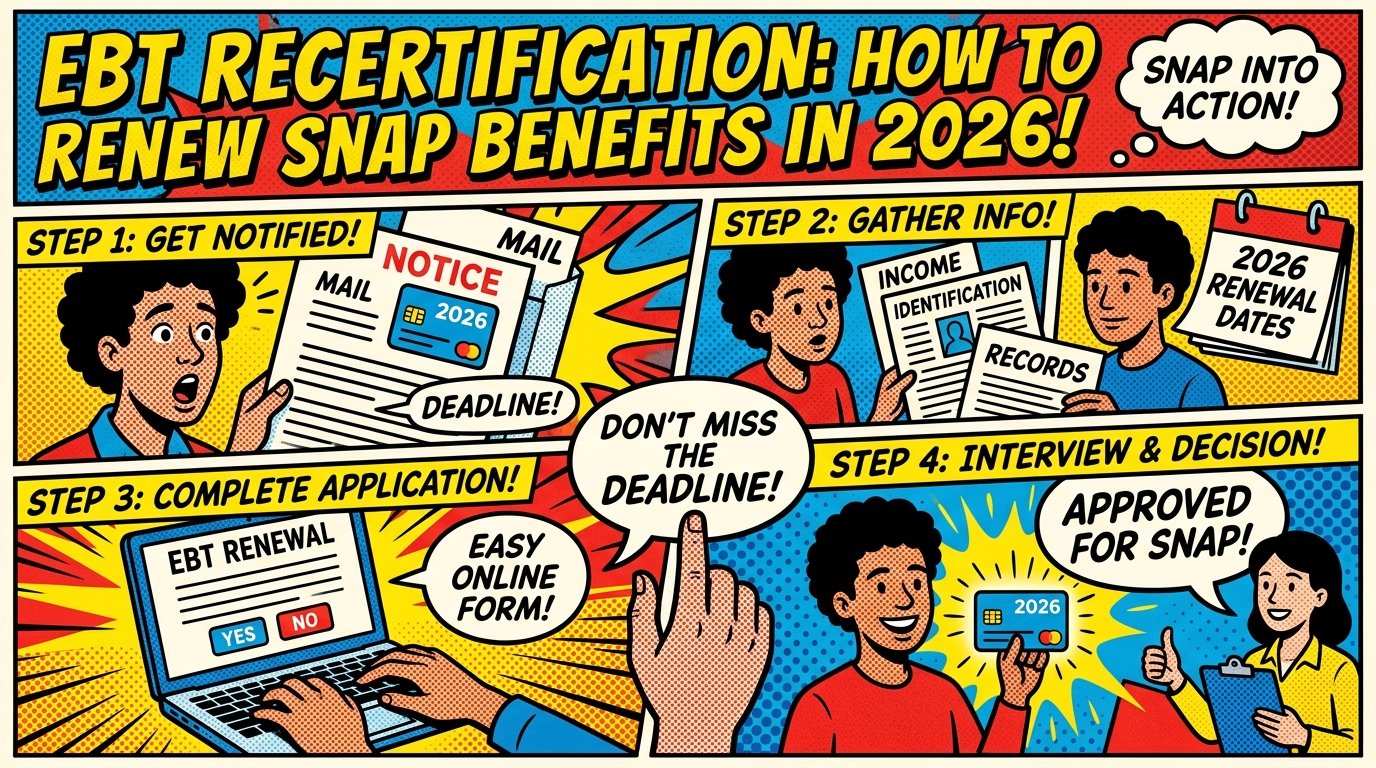
The recertification process has four core steps: the notice, the renewal form, the interview (if required), and verification. Missing any one of them can interrupt benefits.
Step 1: Watch for the Notice of Expiration
Federal regulation (7 CFR 273.14) requires the state SNAP agency to send a Notice of Expiration (NOE) before the first day of the last month of the certification period, and not earlier than the first day of the next-to-last month. In practice, the notice generally arrives 30 to 45 days before benefits end. It states the exact end date of the certification period, the filing deadline for uninterrupted benefits, and how to file (online, mail, phone, in person, or fax).
The biggest failure point is a notice that never reaches the household. States mail to the address on file, and many still default to paper even when an online account exists. Households that have moved, lost mail forwarding, or share a mailbox should check their state benefits portal for the certification end date rather than relying solely on mail.
Step 2: File the Renewal Form by the 15th
Under federal rules, a recertification application is timely if it is filed by the 15th day of the last month of the certification period. A renewal filed between the 1st and 15th of the last month preserves uninterrupted benefits. A renewal filed between the 16th and the last day of the month is untimely and loses the right to uninterrupted benefits. A renewal filed within 30 days after the certification period expires is a late renewal and may be treated as a recertification, but benefits are prorated from the date the valid form is received.
Georgia’s policy manual states the rule directly: “A timely renewal is an application for continued benefits submitted by the AU between the 1st and 15th day of the last month of the certification period. Eligible AUs are entitled to receive uninterrupted benefits.”
Step 3: Complete the Interview
A face-to-face or telephone interview is required at initial certification and at least once every 12 months thereafter for recertification. States may not require households to report for an in-office interview during their certification period, but they must conduct an interview at recertification at least once every 12 months. The interview can be conducted by telephone, and states must grant a face-to-face interview to any household that requests one.
The interview is where the caseworker reviews incomplete information, screens for exemptions from SNAP rules, resolves questionable or inconsistent information, explains rights and responsibilities, and identifies verification requirements. It is not a formality; the interview is the most important step in ensuring accurate benefits.
Some states have expanded interview requirements. Multnomah County, Oregon, announced that starting June 1, 2026, anyone applying for or renewing SNAP must complete an interview, including households that previously did not need one, such as those in which all adults are 60 or older. ESAP households in states that operate the project are generally exempt from the recertification interview unless questions arise.
Step 4: Provide Verification Documents
The caseworker will identify required verification during the interview. Households generally must provide proof of income, identity, residency, household composition, expenses (shelter, utilities, child care, medical costs for elderly or disabled members), and immigration status where applicable. The verification deadline must be at least 10 days from the request. If all four steps—notice, form, interview, and verification—are completed before the certification period ends, the EBT card continues loading on the normal schedule.
Recertification Deadlines: Timely, Untimely, and Late
Deadline rules determine whether benefits continue without a gap. The categories are consistent across states, even when the exact dates shift.
Filing status
When the renewal is filed
Effect on benefits
Timely
Between the 1st and 15th of the last month of the certification period
Eligible for uninterrupted benefits by the normal issuance cycle
Untimely
Between the 16th and the last day of the last month
Loses the right to uninterrupted benefits; benefits may be prorated or delayed
Late
Within 30 days after the certification period expires
May be treated as a recertification application, but benefits are prorated from the date the valid form is received
Ohio sets a shorter timeline for expedited households: an assistance group certified for expedited benefits has 15 days from the date the notice of expiration is received to file for recertification timely.
Important: Filing by the 15th preserves the uninterrupted-benefit right, but it does not guarantee benefits if the household misses the interview or fails to provide verification. All steps must be completed in time.
Recertification Interviews: What to Expect
The interview is a conversation, not a test. The caseworker will review the renewal form with you, ask about income and household changes, explain what verification is needed, and answer questions. You may bring any person you choose to the interview, and the interview must be conducted as an official and confidential discussion of household circumstances.
What the interviewer must do:
Discuss aspects of the application the household did not complete.
Screen household members for exemptions from certain SNAP rules.
Identify and resolve questionable or inconsistent information.
Explain complex rules and answer questions.
Explain household rights and responsibilities.
Identify all verification requirements and assist the household in obtaining needed verification.
Telephone vs. in-person: States may use a telephone interview instead of a face-to-face interview for all households, for specified categories, or on a case-by-case basis because of hardship—such as illness, transportation difficulties, care of a household member, rural residency, severe weather, or work or training hours. If a state has not already scheduled a telephone interview and the household meets the hardship criteria and requests not to have an in-office interview, the state must offer a telephone interview. The state must also grant a face-to-face interview to any household that requests one.
Who can be interviewed: The head of household, spouse, any other responsible member of the household, or an authorized representative. The applicant may bring anyone he or she chooses.
Required Documents for Recertification
Requirements vary by state and household, but most recertifications require:
Proof of identity for the head of household.
Proof of income for all household members—pay stubs, employer statements, or benefit award letters for the most recent period.
Proof of residency in the state.
Social Security numbers for household members, or proof of application.
Proof of household composition—who lives in the home and their relationship.
Proof of shelter and utility expenses (rent or mortgage statement, utility bills).
Proof of child care costs if claiming the child care deduction.
Proof of medical expenses for elderly or disabled household members claiming the medical expense deduction.
Immigration documents for noncitizen household members.
Proof of any change reported since the last certification—new job, new household member, move, or change in expenses.
The verification deadline must be at least 10 days from the request. Missing documents is one of the most common reasons recertification is delayed or denied.
State Differences in Recertification
Recertification rules are set by state SNAP agencies within federal parameters, so timelines, certification lengths, interview practices, and online portals vary significantly.
California: Most households recertify every 12 months; some elderly or disabled households may have 24-month certification periods.
Florida: The most common certification period is 6 months, meaning Florida households recertify more frequently than households in many other states.
New York and Texas: Both states use varying certification periods and send individualized notices to each household rather than applying a single statewide length.
Ohio: Standard households receive 12 months; elderly/disabled households with no earned income receive 36 months; households with unstable circumstances or an able-bodied adult receive 6 months (or 4–5 months in some cases).
Georgia: Timely renewals are filed between the 1st and 15th of the last month; periodic reporting is being phased out for regular SNAP households as the state terminated extended certification periods effective March 2026.
States with ESAP: At least 25 states have implemented the Elderly Simplified Application Project, which extends certification to 36 months, waives the recertification interview in most cases, and simplifies verification for households in which all adults are 60 or older or have a disability and have no earned income.
Online portals:43 states offer online recertification through state-run or MyCase-style portals. Examples include MyDHR in Alabama, Alaska Connect, MyFamilyBenefits, OKDHSLive in Oklahoma, ONE Oregon, and the Kansas DCF self-service portal.
Reasons Recertifications Are Denied or Benefits Stop
Recertification can result in denial or case closure for several reasons:
Missing the filing deadline. A renewal filed after the certification period ends may be treated as a new application and prorated, or it may be denied if filed too late.
Missing the interview. A required interview that is not completed can result in denial, even if the form was filed on time.
Missing verification. Failure to provide required documents by the deadline is one of the most common reasons SNAP cases close at recertification. Courts have upheld denials where households “refused to provide sufficient information to verify” eligibility.
Income now exceeds the limit. If household income has risen above the applicable gross or net limit, the household is no longer eligible.
Household composition changes. A household that no longer includes an eligible member may lose eligibility.
Immigration status changes. Changes in immigration status can affect eligibility, and recertification is when those changes are reviewed.
Failure to meet ABAWD work requirements.Able-bodied adults without dependents must document 80 hours per month of qualifying activity; failure can result in loss of benefits after three months in a 36-month period.
Failure to complete an interim report in states that require one can close the case before recertification even begins.
Important distinction: A case closure for a missed interim report is often easier to reinstate than a denial at recertification. Confusing the two forms is a common reason benefits stop.
What to Do If You Miss the Recertification Deadline
If the certification period has already ended, the options depend on how much time has passed and what step was missed.
If you file within 30 days after the certification period ends: The application is considered an application for recertification, but benefits are prorated from the date the valid form is received. You do not automatically receive retroactive benefits for the gap period.
If you complete the required action after the certification period ends but within 30 days: The state must reopen the case and provide benefits retroactive to the date the household takes the required action.
If you complete the required action before the certification period ends (for example, providing verification that was outstanding): The state must reopen the case and provide a full month’s benefits for the initial month of the new certification period.
If the delay was the state’s fault: If an eligible household files before the end of the certification period but the recertification cannot be completed within 30 days because of state agency fault, the state must continue processing and provide a full month’s allotment for the first month of the new certification period.
If benefits were stopped for ABAWD work requirements: Eligibility can be regained by meeting the work requirement or qualifying for an exemption, but a new application is generally required to resume benefits. Some states allow eligibility restoration if the household provides proof before the end of the third month that it will meet ABAWD requirements within an additional 30 days.
Practical step: File a new application immediately if the recertification window has closed. Do not wait for the state to contact you.
Appeals Process
A household that disagrees with a recertification denial or benefit reduction has the right to a fair hearing. The denial notice includes instructions and the deadline for requesting a hearing. Deadlines vary by state—90 days is common for SNAP—and a household that requests a hearing before the deadline may be able to keep benefits at the prior level while the hearing is pending, depending on state rules.
Courts have reversed recertification denials where the state failed to properly notice the household of the documentation deadline. In one New Jersey case, an administrative law judge reversed a denial because the agency had not properly notified the petitioner of the deadline to submit documents to prevent case closure. This underscores the importance of reading every notice carefully and keeping proof of submission.
A household can appeal and reapply at the same time. Filing an appeal does not prevent a new application, and a new application may restore benefits faster while the appeal is pending.
Common Mistakes That Cause Recertification Problems
Missing the 15th-of-the-month filing deadline. Filing on the 16th or later forfeits the right to uninterrupted benefits.
Confusing the interim report with recertification. An interim report is a short mid-period check-in; recertification is a full redetermination. Treating them as the same can lead to a missed recertification.
Ignoring the Notice of Expiration. The notice states the exact end date and filing deadline; households that move or lose mail may never see it. Check the online portal for the certification end date.
Not completing the interview. A filed form without a completed interview can still result in denial.
Missing the verification deadline. The state must give at least 10 days, but missing that window can close the case.
Failing to report changes during the certification period. Unreported income or household changes can create overpayments or trigger a denial at recertification.
Assuming benefits renew automatically. SNAP recertification is not automatic; every standard household must act.
Not appealing a denial. A denial can often be challenged, and some denials are reversed when the state failed to provide proper notice.
Recent Changes: The One Big Beautiful Bill and 2026 Rules
The One Big Beautiful Bill Act (OBBBA), enacted in July 2025, made significant changes to SNAP that affect recertification in 2026. The law:
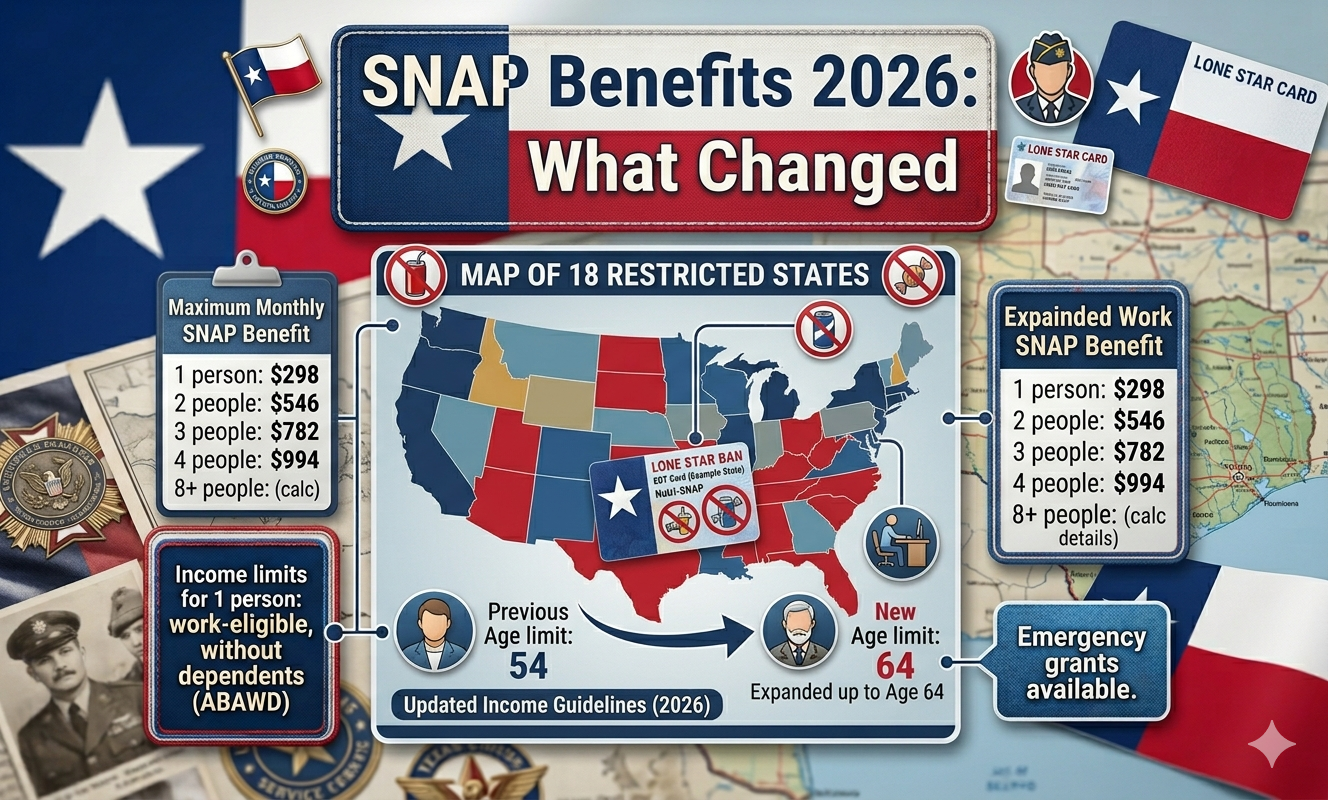
Expanded work requirements to able-bodied adults up to age 64 (raised from 54). Adults must document 80 hours per month of work, volunteering, or training—about 20 hours per week.
Increased documentation requirements at application and recertification. Households must provide proof of work hours and qualifying activities, not just answer questions.
Removed certain exemptions, including exceptions for homeless people and veterans, and changed eligibility for many lawful immigrants.
Required more frequent recertification in some states. Illinois moved to reapplications every six months instead of annually, and other states have shortened certification periods.
Work requirements apply at the next recertification. For SNAP participants who were already receiving benefits before the new rules took effect, the work requirements apply at their next recertification, not immediately. States began implementing the changes on different timelines—some starting in late 2025, others on March 1, 2026, and others on June 1, 2026.
Federal oversight of recertification timeliness has tightened. As of April 2025, 20 state agencies were failing to meet federal requirements for recertifications, and USDA announced a five-step escalation process, corrective action plans, and federal oversight teams to bring non-compliant states into line. A recertification is considered processed timely when the eligible household has access to its benefit allotment by its normal issuance date.
ESAP expansion continues. At least 25 states have implemented the Elderly Simplified Application Project, which extends certification to 36 months, waives the recertification interview, and simplifies verification for households in which all adults are 60 or older or have a disability and no earned income. Hawaii legislation advanced in 2026 would require the state to establish 36-month recertification periods for these households and participate in ESAP.
Practical Examples: Recertification Scenarios
These examples are illustrative, not official determinations. Rules vary by state.
Example 1: Single mother with two children, income unchanged
A single mother in Ohio with two children has been on SNAP for 12 months. Her income has not changed. Her certification period ends June 30. She receives the Notice of Expiration in May, files the renewal form on June 10 (before the 15th), completes her phone interview on June 18, and submits pay stubs by June 25.
Outcome: Her renewal is timely, and benefits continue without a gap. Because nothing changed, her benefit amount stays the same.
Example 2: Family of four with a new job
A family of four in Florida has a 6-month certification period. The father started a new job two months before recertification. At the interview, the caseworker requests proof of the new income. The family submits pay stubs showing $3,200 per month in gross income. The household passes the gross income test but the new income reduces the benefit amount after the earned income deduction.
Outcome: The family remains eligible but at a lower monthly benefit. If the new income had pushed the household above the net income limit, the recertification would be denied.
Example 3: Senior receiving SSI, ESAP household
A 68-year-old in a state that operates ESAP receives SSI and has no earned income. Her household is certified for 36 months. She receives a recertification notice at the end of the 36-month period but is not required to complete an interview because ESAP waives the interview in most cases.
Outcome: She completes the simplified renewal form and provides updated verification. Her certification is renewed for another 36 months if she remains eligible.
Example 4: Disabled worker who misses the interview
A disabled worker with a child files the renewal form on time but misses the scheduled interview because of a medical appointment. The state denies the recertification. The worker calls the SNAP office, explains the situation, and completes the interview the following week, still within the certification period.
Outcome: Because the required action was completed before the certification period ended, the state must reopen the case and provide a full month’s benefits for the first month of the new certification period.
Example 5: College student who is a single parent
A single parent in college files the renewal form on the 16th of the last month—untimely. She completes the interview and provides verification, but her benefits are prorated because she missed the timely filing window.
Outcome: She remains eligible but receives a partial benefit for the first month of the new certification period because the renewal was untimely. If she had filed by the 15th, benefits would have been uninterrupted.
Example 6: ABAWD who did not document 80 hours
An able-bodied adult without dependents in a state implementing OBBBA work rules recertifies. He worked 60 hours per month, below the 80-hour requirement, and did not qualify for an exemption. The state denies the recertification.
Outcome: He loses SNAP eligibility. To regain benefits, he must meet the work requirement or qualify for an exemption and file a new application. Some states allow restoration if he provides proof before the end of the third month that he will meet the requirement within an additional 30 days.
Example 7: Veteran with a child and no income change
A veteran with a child files the renewal form by the 15th, completes the interview, and provides verification. His only income is VA disability benefits, which have not changed.
Outcome: His recertification is timely, and benefits continue at the same amount. He should also check whether VA benefits affect his SNAP countable income and whether he qualifies for any veteran-specific exemptions under current rules.
Example 8: Retired couple raising a grandchild, late renewal
A retired couple caring for a grandchild misses the certification end date and files the renewal 20 days after the period ends. The state treats the filing as a late renewal and prorates benefits from the date the valid form is received.
Outcome: The couple remains eligible but loses benefits for the gap period. If they had filed before the certification period ended, benefits would have continued without interruption. If they file within 30 days after the period ends, the application is still treated as a recertification, but with proration.
SNAP Recertification vs. Other Renewals
Program
Renewal frequency
Interview required?
Asset limit
Online renewal
Processing standard
SNAP
Every 6–36 months, depending on state and household type
Yes, at least once every 12 months
Varies by state; many states use BBCE and no asset test for most households
Yes, in 43 states
Timely when benefits are available by normal issuance date; 30 days standard
TANF
Varies by state; often 6–12 months
Yes, generally at renewal
Varies by state
Yes, in most states
Varies by state
Medicaid
12 months for most adults; longer for some groups
Generally no interview
No asset test for MAGI-based eligibility
Yes, through state Medicaid or health exchange portals
45 days for most determinations
SSI
Annually or when circumstances change
No routine interview; SSA reviews income and resources
$2,000** individual / **$3,000 couple
Limited; SSA largely uses mail and phone
Varies; redeterminations can take months
LIHEAP
Annually, before the heating season
Generally no interview
Varies; categorical eligibility through SNAP or SSI is common
SNAP has the most frequent and most variable recertification cycle of the major benefit programs. Certification periods range from 4 months to 36 months depending on state policy and household circumstances.
SNAP requires an interview at least once every 12 months; Medicaid generally does not require an interview, and SSI does not routinely require one.
SNAP recertification is not automatic. Medicaid renewals may be processed through data matching in some cases, but SNAP households must file a renewal form and complete an interview.
Missing a SNAP recertification can mean proration or a gap in benefits, while SSI and Medicaid have different reinstatement rules.
Related Government Benefits
Households that receive SNAP often qualify for other programs. Recertification is a good time to check whether circumstances have changed eligibility for these benefits:
TANF (Temporary Assistance for Needy Families) — Monthly cash assistance for families with children. Recertification periods are set by state TANF agencies.
Medicaid — Health coverage for low-income children, parents, pregnant women, seniors, and people with disabilities. Apply through the state Medicaid agency or Health Insurance Marketplace.
CHIP (Children’s Health Insurance Program) — Low-cost health coverage for children whose family income is too high for Medicaid.
LIHEAP (Low Income Home Energy Assistance Program) — Utility bill assistance for eligible low-income households; SNAP recipients are often categorically eligible.
Section 8 Housing Choice Voucher — Rental assistance through local public housing agencies and HUD.
WIC (Special Supplemental Nutrition Program for Women, Infants, and Children) — Food and nutrition assistance for pregnant women, new mothers, and young children.
Child Care Assistance — Help paying for child care while parents work or participate in education or training.
Earned Income Tax Credit (EITC) — A refundable federal tax credit for low- and moderate-income workers.
Child Tax Credit — A federal tax credit for families with qualifying children.
Emergency rental and utility assistance — Local programs that may be available through city, county, or nonprofit agencies.
Common Questions
What is EBT recertification?
EBT recertification is the process of renewing your SNAP eligibility before your certification period ends. It requires filing a renewal application, completing an interview if required, and providing verification. Benefits do not continue automatically after the certification period ends.
How often do I need to recertify for SNAP?
Most households recertify every 6 to 12 months. Certification periods depend on state policy and household circumstances. ESAP households (all adults 60+ or disabled, no earned income) may recertify every 36 months in states that operate the project.
When is the SNAP recertification deadline?
Under federal rules, a renewal is timely if it is filed by the 15th day of the last month of your certification period. Filing by the 15th preserves uninterrupted benefits. A renewal filed between the 16th and the last day is untimely and loses the right to uninterrupted benefits.
Do I need an interview for SNAP recertification?
Yes, in most cases. Federal rules require an interview at initial certification and at least once every 12 months thereafter for recertification. States may conduct the interview by telephone. ESAP households are generally exempt from the recertification interview in states that operate the project.
What happens if I miss my SNAP recertification deadline?
If you file within 30 days after the certification period ends, the application is treated as a recertification but benefits are prorated from the date the valid form is received. If you file after that, you may need to submit a new application. Benefits are not automatically restored for the gap period.
Can I complete SNAP recertification online?
Yes, in most states. 43 states offer online recertification through state-run or MyCase-style portals. Check your state SNAP agency’s website or your benefits portal for the online renewal option.
What documents do I need for SNAP recertification?
Typically, you need proof of income, identity, residency, household composition, and expenses (shelter, utilities, child care, and medical costs for elderly or disabled members). The caseworker will tell you exactly what is required during the interview, and you must be given at least 10 days to provide it.
What is the difference between an interim report and recertification?
An interim report is a short mid-period check-in on income and household changes, usually at month 6 of a 12-month period. Recertification is a full redetermination of eligibility at the end of the certification period. An interim report usually does not require an interview; recertification does.
What happens if my income changed before recertification?
Your benefit amount is recalculated based on your current income. If your income has increased but you remain under the applicable limits, you may receive a lower benefit. If your income exceeds the gross or net limit, your recertification may be denied. Report changes during the certification period as required by your state.
How do the One Big Beautiful Bill work requirements affect recertification?
Starting in 2026, able-bodied adults up to age 64 must document 80 hours per month of work, volunteering, or training. The requirements apply at your next recertification after the rules take effect in your state. Failure to document sufficient hours can result in loss of benefits after three months in a 36-month period.
What if my recertification is denied because of a state error?
If the delay or denial was caused by state agency fault, the state must continue processing and may owe you benefits back to the date your certification period should have begun. You can request a fair hearing and should keep copies of everything you submitted.
Can I appeal a SNAP recertification denial?
Yes. The denial notice includes instructions and a deadline for requesting a fair hearing. Deadlines vary by state (90 days is common for SNAP). You can appeal and file a new application at the same time to restore benefits faster while the appeal is pending.
Key Takeaways
EBT recertification is a full redetermination of SNAP eligibility that happens at the end of your certification period; benefits do not renew automatically.
File your renewal by the 15th day of the last month of your certification period to keep benefits uninterrupted.
A renewal filed between the 16th and the last day is untimely and loses the right to uninterrupted benefits; a renewal filed within 30 days after the period ends is treated as a recertification but benefits are prorated.
An interview is required at least once every 12 months for recertification, but it can be conducted by telephone, and ESAP households are generally exempt.
Certification periods range from 4 to 36 months depending on state policy and household circumstances; standard households typically recertify every 6 to 12 months.
ESAP households (all adults 60+ or disabled, no earned income) may receive 36-month certification periods and a waived interview in the 25+ states that operate the project.
Missing verification or the interview is a common reason benefits stop; the state must give at least 10 days to provide documents.
The One Big Beautiful Bill expanded work requirements to age 64 and increased documentation requirements; the rules apply at your next recertification after implementation in your state.
File a new application immediately if the recertification window has closed; do not wait for the state to contact you.
You can appeal a denial and reapply at the same time; some denials are reversed when the state failed to provide proper notice of the deadline.