Who Qualifies for FDPIR? Tribal Food Assistance Explained
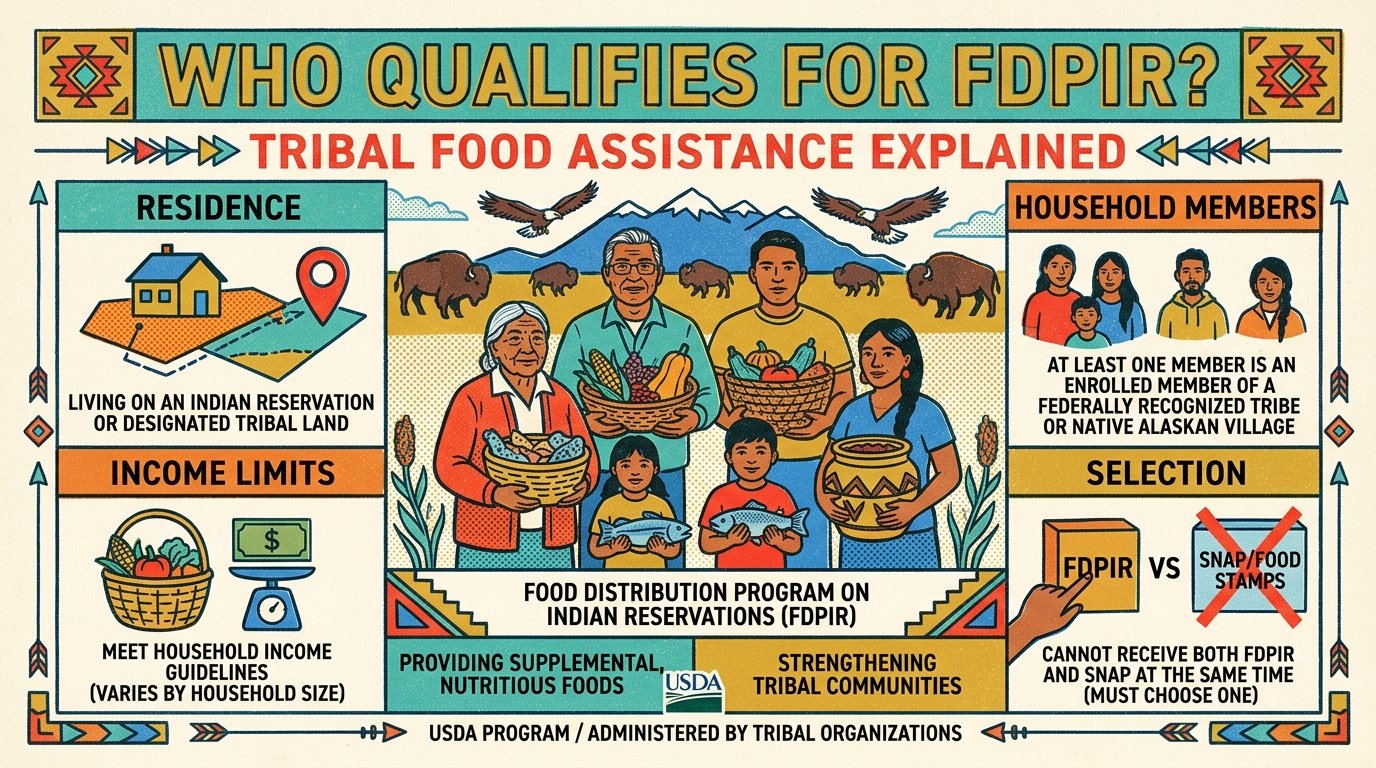
You qualify for FDPIR if you live on a participating reservation and meet the income and resource limits—tribal membership is not required on-reservation. If you live near a reservation or in Oklahoma, at least one household member must be a member of a federally recognized tribe, and you must still meet the income and resource tests. You cannot receive FDPIR and SNAP in the same month.
Quick Facts
Item
Information
Program
Food Distribution Program on Indian Reservations (FDPIR)
Agency
USDA Food and Nutrition Service (FNS); administered locally by Indian Tribal Organizations (ITOs) and state agencies
Eligibility
Income-eligible households on a reservation; near a reservation or in Oklahoma, at least one member must be a member of a federally recognized tribe
Income Limits
FY 2026 net monthly: $1,514 (1 person) to $4,812 (8 people); +$459 per additional member
Monthly Benefit
Food package, not cash; over 100 products, issued monthly
7 working days standard; 1 business day expedited for qualifying households
Renewal
At least every 12 months; up to 24 months for households where all members are elderly and/or disabled
Available Areas
Approved service areas on or near reservations and in Oklahoma; not nationwide
Last Updated
2026
What Is FDPIR?
FDPIR is a USDA food distribution program that provides a monthly package of USDA Foods—not cash or EBT—to low-income households on or near Indian reservations. It is an alternative to SNAP for households with limited access to SNAP offices or authorized grocery stores. USDA’s Food and Nutrition Service (FNS) administers the program at the federal level, while ITOs and state agencies determine eligibility locally, distribute the food, and provide nutrition education.
The program operates in approved service areas, not nationwide. As of recent FNS figures, approximately 276 tribes receive FDPIR benefits through 102 ITOs and 3 state agencies. FDPIR is authorized under the Food and Nutrition Act of 2008 and the Agriculture and Consumer Protection Act of 1973.
Key distinction: FDPIR is a food package program, not a cash benefit. You choose from a list of available USDA Foods, and the local agency issues the food.
Who Qualifies for FDPIR?
FDPIR eligibility turns on three factors: (1) where you live, (2) tribal membership—but only in certain areas—and (3) your net income and resources. The rules are different for households on a reservation versus households near a reservation or in Oklahoma.
On a reservation
All low-income families and individuals living on a reservation can participate in FDPIR, if they meet the eligibility criteria. This includes non-Indian households and households with no tribal members. Tribal membership is not required on-reservation.
The household must still meet the income and resource standards similar to SNAP rules. The food package is available to eligible American Indian and non-Indian households on the reservation.
Near a reservation or in Oklahoma
Households in approved areas near a reservation or in Oklahoma must contain at least one person who is a member of a federally recognized tribe, in addition to meeting the income and resource tests. The household must live in an approved service area; not every area near a reservation qualifies.
Who does NOT qualify
Households outside an approved FDPIR service area. FDPIR is not available everywhere.
Near-reservation or Oklahoma households with no member of a federally recognized tribe, even if income-qualified.
Households with net income above the FY 2026 standard after allowable deductions.
Households with countable resources above the applicable limit, including $3,000 for households with a disabled member.
Households receiving SNAP in the same month. Dual participation is prohibited.
Households that do not complete the application, certification interview, or verification process.
Individuals disqualified from SNAP for fraud are not eligible for FDPIR until the SNAP disqualification period ends.
Common exceptions and special rules
Situation
FDPIR treatment
Non-Indian household on a reservation
Eligible if income-qualified; no tribal membership requirement on-reservation
Household near a reservation with one enrolled tribal member
Eligible if income-qualified and in an approved service area
All household members elderly and/or disabled
May be certified for up to 24 months instead of 12
Household with a disabled member
Resource limit of $3,000
Zero-income household
Can qualify if other eligibility rules are met
Non-citizen household
May participate at the option of the ITO or state agency; the agency may choose to serve or not serve non-citizens
Household switching from SNAP
Allowed month to month; cannot receive both in the same month
Income Limits for FDPIR in 2026
FDPIR uses net monthly income standards, and the FY 2026 limits range from $1,514 for one person to $4,812 for eight people, with $459 added for each additional member. These standards are the sum of the applicable SNAP net monthly income standard and the SNAP standard deduction for each household size.
Household Size
FY 2026 Net Monthly Income Limit
1
$1,514
2
$1,972
3
$2,430
4
$2,903
5
$3,399
6
$3,895
7
$4,354
8
$4,812
Each additional member
+$459
Source: USDA FNS, FDPIR Net Monthly Income Standards – FY 2026 (effective Oct. 1, 2025 – Sept. 30, 2026).
These are net limits, not gross. FDPIR allows deductions before comparing income to the standard.
A household with gross income above the chart may still qualify if deductions bring net income below the limit.
The standards are updated annually and apply for the federal fiscal year.
Income deductions that can help you qualify
FDPIR allows several deductions before applying the net income standard:
Shelter and utility deduction. Beginning December 30, 2024, households may choose either a standard deduction or actual shelter/utility expenses up to 50% of net monthly income. For FY 2025, the standard deduction was $712** for the 48 contiguous states and **$1,137 for Alaska.
Dependent care for children or disabled dependents.
Child support paid to someone outside the household.
Medical expenses for elderly or disabled household members.
Practical point: Because FDPIR uses net income, the deduction calculation often determines whether a household qualifies. Ask the certifying worker to walk through your deductions before assuming you are over the limit.
Asset and Resource Limits
FDPIR uses SNAP-aligned resource limits, and the key figure is $3,000 for households with a disabled member. The program does not have a separate, independent asset test, but it does count countable resources toward a maximum.
Household type
Resource limit
Households with a disabled member
$3,000
Most other households
SNAP-aligned resource limits apply
Prepaid funeral arrangements
Up to $1,500 of the equity value of one prepaid funeral arrangement per household member may be excluded
Retirement and education savings accounts may be excluded under SNAP-aligned rules. The local administering agency applies the exclusions; ask the certifying worker which resources count.
Household Requirements
FDPIR defines a household as a group of people who live together and share food and resources. Household size determines the income limit and the food package amount.
Temporary absences (vacations, visits with relatives) do not break household membership.
Children placed in a relative’s home by a social services agency are generally included in the relative’s household if the minor is counted as a household member.
If the only adult in a household is disqualified, children may still participate with an authorized representative acting as head of household.
Household composition affects the net income standard and the food package size.
Citizenship and Immigration Rules
FDPIR does not require U.S. citizenship at the federal level, but the local ITO or state agency decides whether to serve non-citizens.
FNS guidance states that a person who is not a U.S. citizen may participate in FDPIR at the option of the ITO or state agency. The agency may choose to serve or not serve non-U.S. citizens or unqualified aliens, and that decision must be stated in the agency’s Plan of Operation or written guidance.
This means:
On-reservation households, including non-citizen households, may qualify if the local agency chooses to serve them and the household meets income and resource rules.
Near-reservation and Oklahoma households still need at least one member of a federally recognized tribe, regardless of citizenship.
Immigration status is not a blanket federal bar, but local policy controls. Ask the administering agency directly.
Bottom line: FDPIR is generally more accessible to non-citizens than SNAP or SSI because citizenship is not a federal eligibility requirement, but the local agency’s policy is the deciding factor.
State and Service Area Differences
FDPIR is not available nationwide, and the local administering agency controls key details.
Not every reservation participates. Some tribes operate FDPIR; others do not.
Approved near-reservation areas are designated locally.
Oklahoma has a special rule: Native American households in approved areas can qualify without living on a reservation.
Food package selection, distribution methods, and hours vary by ITO or state agency. USDA makes nearly 100 food items available, and each ITO chooses which foods it will provide.
The food package itself varies based on what the tribe orders, seasonal availability, and storage capacity.
Action step: Contact your tribal organization or the USDA FNS regional office to confirm whether your address is in an FDPIR service area and which agency administers the program.
Required Documents
Requirements vary by administering agency, but most FDPIR applications require:
Utility bill, lease, rent receipt, or similar document
Proof of tribal membership
CDIB or tribal enrollment documentation, where required (near-reservation and Oklahoma households)
Social Security numbers
For household members, where available
Proof of income for the last 30 days
Pay stubs, benefit letters, pension statements, or a statement of no income
Proof of deductible expenses
Child care, medical expenses, child support paid, shelter/utility costs if using actual expenses
Note: A complete application must contain the applicant’s name, address, and signature. Additional household information is obtained at the certification interview, which is required before certification.
How to Apply for FDPIR
FDPIR applications are handled locally through an Indian Tribal Organization or state distributing agency—there is no national online application.
Step-by-step
Step 1: Confirm your service area. Contact your tribal organization or the USDA FNS regional office to find out whether FDPIR operates at your address and which agency administers it.
Step 2: Contact the administering agency. Call or visit the local ITO or state distributing agency. Ask for the application and the document list.
Step 3: Complete the application and certification interview. Submit the application and complete an interview with a certification worker. All applicant households must have an interview before certification.
Step 4: Provide verification. Submit proof of identity, residency, income, and tribal membership where required. If verifications cannot be completed within 7 working days, the agency may certify the household for one month if the application is complete and the household appears eligible.
Step 5: Receive your food package. Once certified, you will be told when and how to receive your monthly food package.
Online Application
There is no national online application for FDPIR. Application methods vary by ITO or state agency. Some agencies accept mailed, faxed, or in-person applications; some may offer phone assistance or authorized-representative filing. Start by calling the local administering agency to confirm its process.
Traditional foods, depending on what the tribe orders
Frequency and value
Frequency:Monthly, based on household size and the local distribution schedule.
Value: The package is not a cash entitlement, and the value varies by household size and food selection. USDA does not publish a fixed per-person cash value; the benefit is the food itself.
Distribution methods: Over-the-counter pickup, grocery-store-style selection, tailgating, or home delivery, depending on the tribe.
Renewal and Recertification
FDPIR households must be recertified to continue benefits.
Standard recertification:At least every 12 months.
Elderly and/or disabled households: May be certified for up to 24 months if all household members are elderly and/or disabled.
Reporting changes: Households must report changes in income, household composition, and residency that affect eligibility.
Reasons Applications Are Denied
Reason
What it means
Outside the service area
Your address is not on a participating reservation or in an approved near-reservation/Oklahoma area
No eligible tribal member
For near-reservation or Oklahoma households, no member is enrolled in a federally recognized tribe
Income above the net standard
Countable net income exceeds the FY 2026 limit for your household size
Resources above the limit
Countable resources exceed the SNAP-aligned limit, including $3,000 for households with a disabled member
Receiving SNAP in the same month
Dual participation is prohibited
Incomplete application or failed verification
Missing documents, no interview, or unverifiable information
SNAP fraud disqualification
A person disqualified from SNAP for fraud is not eligible for FDPIR until the disqualification period ends
Appeals Process
FDPIR applicants have appeal rights, but the process is administered locally.
Ask for a written denial notice explaining the reason and appeal instructions.
Follow the local fair hearing process established by the ITO or state agency consistent with FNS requirements. Telephonic and virtual fair hearings are allowed.
Present evidence and testimony at the hearing.
Contact the USDA FNS regional office if you believe the local agency did not follow federal FDPIR rules.
Practical tip: Request the appeal instructions in writing at the time of denial.
Common Mistakes
Assuming FDPIR is available everywhere. It operates only in approved service areas.
Applying while receiving SNAP. You cannot receive both in the same month.
Using gross income instead of net income. FDPIR allows deductions that can bring you under the limit.
Not providing proof of tribal membership when applying near a reservation or in Oklahoma.
Missing the certification interview. A complete application alone is not enough.
Not reporting household changes. Income and household composition affect eligibility and package size.
Assuming the food package is cash. It is a selection of foods, not a deposit or EBT card.
Not asking about expedited service when you have very low or no income.
Recent Changes (2024–2026)
2024 final rule (published October 31, 2024) updated FDPIR regulations to increase access and parity with SNAP.
New shelter/utility deduction (effective December 30, 2024): Households may choose a standard deduction or actual shelter/utility expenses up to 50% of net monthly income.
Resource limits aligned with SNAP, including $3,000 for households with a disabled member** and a **$1,500 funeral-arrangement exclusion per household member.
Extended certification: Households where all members are elderly and/or disabled may be certified for up to 24 months.
FY 2026 income standards took effect October 1, 2025, and run through September 30, 2026.
Practical Examples: Who May Qualify
Family of four on a reservation, net monthly income $2,800.** **Likely eligible.** The 4-person FY 2026 limit is **$2,903, and the household is on a reservation. Non-Indian households on a reservation can qualify based on income.
Household of two near a reservation, one tribal member, net income $1,900.** **Likely eligible.** The 2-person limit is **$1,972, and the household includes a member of a federally recognized tribe in an approved near-reservation area.
Household of three near a reservation, no tribal members, net income $2,000. Not eligible. Near-reservation households must include at least one member of a federally recognized tribe, even if income is below the standard.
Senior receiving SSI, living alone on a reservation, net income $1,400.** **Likely eligible.** The 1-person limit is **$1,514. If all household members are elderly and/or disabled, certification may last up to 24 months.
Disabled worker living alone, resources $2,500, net income $1,600. Likely eligible on resources. The **$3,000 limit for households with a disabled member** is met at $2,500. Income of $1,600 is above the 1-person limit of $1,514 unless deductions reduce it; the household should verify the deduction calculation.
Household currently receiving SNAP. Not eligible for FDPIR in the same month. The household can switch between programs month to month but cannot receive both simultaneously.
College student on a reservation with low income. May qualify if the student meets the household definition and net income test. Household composition rules apply.
Veteran on a reservation, VA pension counted as income, net income $1,450.** **Likely eligible.** The 1-person limit is **$1,514, and VA benefits are countable income. Medical and shelter deductions may further reduce net income.
Comparison: FDPIR vs. SNAP
Feature
FDPIR
SNAP
Benefit form
Monthly food package
EBT card for authorized stores
Where available
Approved service areas on or near reservations and in Oklahoma
Nationwide
Who administers
ITOs and state distributing agencies
State SNAP agencies
Income test
Net monthly standards (FY 2026: $1,514–$4,812)
Gross and net income tests
Resource test
SNAP-aligned, including $3,000 for disabled-member households
SNAP resource rules
Dual participation
Cannot receive FDPIR and SNAP in the same month
Cannot receive both in the same month
Citizenship
Not a federal requirement; local agency option
Federal eligibility rules apply
Best for
Households with limited access to authorized grocery stores
Who qualifies for FDPIR? Low-income households on a participating reservation qualify if they meet income and resource limits, even without tribal members. Near a reservation or in Oklahoma, at least one household member must be a member of a federally recognized tribe, and the household must meet the same income and resource tests.
Do I have to be Native American to get FDPIR? Not if you live on a reservation. Non-Indian and non-tribal households on a reservation can qualify based on income. Near a reservation or in Oklahoma, at least one household member must be a member of a federally recognized tribe.
What is the income limit for FDPIR in 2026? FY 2026 net monthly limits are $1,514 (1 person), $1,972 (2), $2,430 (3), $2,903 (4), $3,399 (5), $3,895 (6), $4,354 (7), and $4,812 (8), plus $459 per additional member.
Are FDPIR income limits gross or net? Net. FDPIR allows deductions for shelter and utilities, dependent care, child support paid, and medical expenses before comparing income to the standard.
Can I get FDPIR and SNAP at the same time? No. Federal law prohibits dual participation in the same month. You can switch between programs month to month, but you cannot receive both simultaneously.
Does FDPIR have an asset limit? Yes. FDPIR uses SNAP-aligned resource limits, including $3,000 for households with a disabled member**. Up to **$1,500 of one prepaid funeral arrangement per household member may be excluded.
Can non-citizens get FDPIR? Possibly. FNS guidance allows non-citizens to participate at the option of the local ITO or state agency. The agency may choose to serve or not serve non-citizens, so contact the administering agency directly.
How do I apply for FDPIR? Contact your local Indian Tribal Organization or state distributing agency. Complete the application, attend a certification interview, and provide proof of identity, residency, income, and tribal membership where required.
How long does FDPIR approval take? The standard is 7 working days. Expedited service is available within 1 business day for qualifying households.
How often do I need to recertify? At least every 12 months. Households where all members are elderly and/or disabled may be certified for up to 24 months.
What is in the FDPIR food package? Over 100 products, including fruits, vegetables, proteins, grains, dairy, and traditional foods, depending on what the tribe orders.
What if I am denied FDPIR? Ask for a written denial notice and follow the local fair hearing process. You can also contact the USDA FNS regional office if you believe federal rules were not followed.
Key Takeaways
On-reservation households qualify based on income and resources; tribal membership is not required on-reservation.
Near-reservation and Oklahoma households need at least one member of a federally recognized tribe, plus income and resource eligibility.
FY 2026 net monthly income limits range from $1,514 (1 person) to $4,812 (8 people), with $459 per additional member.
The limits are net, not gross, and the shelter/utility deduction can be either a standard amount or actual expenses up to 50% of net income.
Resource limits are SNAP-aligned, including $3,000 for households with a disabled member.
Non-citizens may participate at the local agency’s option; citizenship is not a federal FDPIR requirement.
You cannot receive FDPIR and SNAP in the same month, but you can switch monthly.
Standard processing is 7 working days; expedited service is 1 business day.
Recertification is required at least every 12 months; elderly/disabled households may be certified for up to 24 months.
There is no national online application; contact your local ITO or state distributing agency.