VDSS Virginia: The Complete Guide to Social Services Benefits
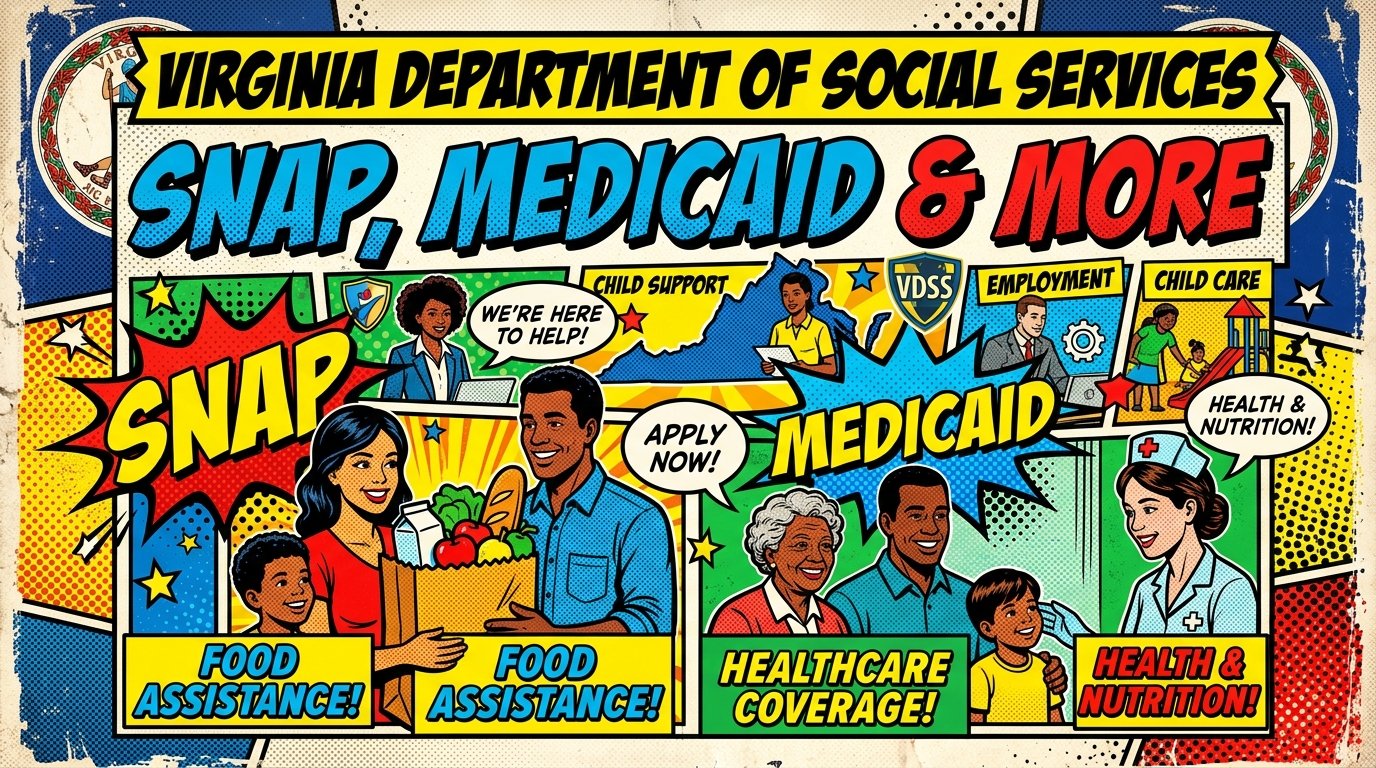
The Virginia Department of Social Services (VDSS) is the state agency that administers a range of public assistance programs, including SNAP food benefits, Medicaid (Cardinal Care), TANF cash assistance, Child Care Subsidy, and Energy Assistance. Eligibility is generally based on household size, income, resources, and specific program rules. You can apply online through CommonHelp or at your local department of social services.
Quick Facts
Item
Information
Program
Virginia Department of Social Services (VDSS) – umbrella agency for multiple benefit programs.
Agency
Virginia Department of Social Services (state supervisory agency). Benefits are delivered through 120 local departments of social services.
Eligibility
Varies by program. Generally based on Virginia residency, household size, income, resources, age, disability, and immigration status.
Income Limits
Set annually. Examples: Medicaid Expansion (adults 19–64) uses 138% of the Federal Poverty Level (FPL). Energy Assistance uses 150% FPL. SNAP and TANF have their own specific limits.
Monthly Benefit
Varies widely. SNAP provides monthly food benefits on an EBT card. TANF provides a monthly cash payment. Medicaid covers medical costs. Energy Assistance provides grants for heating/cooling bills.
Application
Apply online at CommonHelp.virginia.gov, by phone at 855-635-4370, or at your local department of social services.
Processing Time
Varies. SNAP: 30 days (7 days if expedited). TANF: 30 days. Medicaid: 45 days (up to 90 if disability determination is needed). Child Care: 30 days.
Renewal
Most programs require annual renewal (redetermination). You can renew online through CommonHelp.
Available States
Virginia only. Services are delivered through local offices in all 133 localities (counties and independent cities).
Last Updated
October 2026
What Is VDSS?
VDSS is the Virginia Department of Social Services, the state agency responsible for overseeing and administering Virginia’s public assistance and social services programs. It does not deliver all services directly. Instead, VDSS sets policy, provides funding and oversight, and partners with 120 local departments of social services across the Commonwealth to determine eligibility and deliver benefits to residents.
VDSS programs are designed to help low-income families, seniors, individuals with disabilities, and other eligible Virginians meet basic needs for food, health care, housing stability, and financial security. The agency also oversees child support enforcement, child protective services, adult protective services, and refugee resettlement programs.
Who Qualifies for VDSS Programs?
There is no single eligibility standard for VDSS. Each program has its own rules, but most share common thresholds related to income, household size, and Virginia residency. You must apply to receive an official determination.
General Eligibility Factors
Most VDSS benefit programs consider:
Residency: You must live in Virginia.
Household composition: Who lives with you, their relationship to you, and their income.
Income: Both earned income (wages) and unearned income (Social Security, child support, etc.) are counted, though many programs allow deductions.
Resources: Some programs, such as TANF and certain Medicaid groups, have asset limits.
Citizenship or immigration status: Most benefits require U.S. citizenship or qualified non-citizen status. Some programs have different rules for lawfully present immigrants.
Age or disability: Certain programs, like Medicaid for Aged, Blind, or Disabled individuals, require you to be 65 or older, blind, or disabled.
Work requirements: Some programs, including SNAP and TANF (through the VIEW program), require work or participation in work-related activities unless you qualify for an exemption.
Who Does NOT Qualify?
You generally will not qualify for most VDSS benefits if:
You live outside Virginia.
Your household income exceeds the program’s limit.
You are an undocumented immigrant (with limited exceptions for emergency Medicaid).
You fail to provide required verification documents.
You are not a U.S. citizen or qualified non-citizen for programs that require that status.
Common Exceptions
Pregnant women may qualify for Medicaid at higher income levels than other adults.
Children often qualify for Medicaid or FAMIS at higher income levels than their parents.
Seniors and people with disabilities may qualify for Medicaid with higher income and asset limits under the Aged, Blind, or Disabled (ABD) coverage groups.
Households with very low income may receive expedited SNAP benefits within 7 days.
Income Limits
Income limits vary by program and are updated annually, usually each October for SNAP and each January for Medicaid. You can check the current limits for your household size on the official VDSS or CoverVA websites.
Medicaid (Cardinal Care) Income Limits for Adults 19–64
For 2026, Virginia’s Medicaid Expansion program covers adults ages 19–64 with household income under 138% of the Federal Poverty Level (FPL). These figures include a 5% FPL disregard.
Household Size
Yearly Income Limit
Monthly Income Limit
1
$22,025
$1,836
2
$29,864
$2,489
3
$37,702
$3,142
4
$45,540
$3,795
5
$53,379
$4,449
6
$61,217
$5,102
7
$69,056
$5,755
8
$76,894
$6,408
Each additional
$7,839
$654
Energy Assistance Income Limits
The Virginia Energy Assistance Program, funded through the federal Low Income Home Energy Assistance Program (LIHEAP), generally uses 150% of the Federal Poverty Level as its income guideline. For example, in 2026, the gross monthly income limit for a one-person household was $1,995**, and for a four-person household it was **$4,125.
SNAP and TANF Income Limits
SNAP and TANF have their own specific income limits that change annually. SNAP generally requires households to meet both a gross income limit (typically 130% of FPL) and a net income limit (100% of FPL) after deductions. TANF screens gross countable income at 185% of the standard of assistance to determine initial need, and then applies additional deductions to calculate the actual payment. Because these limits change, always verify the current figures with VDSS or your local office.
Asset Limits
Some VDSS programs count assets (resources), while others do not. Medicaid Expansion for adults 19–64 has no asset test. SNAP has no asset limit for most households. TANF and Medicaid for seniors or people with disabilities do have resource limits.
Medicaid Expansion (Adults 19–64): No asset limit. Eligibility is based on income only.
SNAP: Most households have no asset limit. However, households with a member who has been disqualified from SNAP for an intentional program violation may face an asset limit.
TANF: Virginia’s TANF program does count certain resources, such as cash and vehicles, when determining eligibility and benefit amount.
Medicaid for Aged, Blind, or Disabled (ABD): There are resource limits, though they are higher than in the past. A common threshold is $2,000 for an individual and $3,000 for a couple, though some resources are excluded.
Energy Assistance: Generally no asset test; eligibility is based on income and responsibility for a heating or cooling expense.
Household Requirements
Your “household” or “assistance unit” is generally defined by who lives with you and shares income and expenses. The definition can differ slightly by program.
For SNAP, a household is usually a group of people who live together and purchase and prepare food together. Parents and their children under age 22 who live together are generally one SNAP household, even if they buy food separately.
Medicaid Household
For Medicaid, household size is often based on tax filing status. If you file taxes together, you and your dependents are one household. If you file separately, household rules can be more complex. Pregnant women count the unborn child in their household size for Medicaid.
TANF Assistance Unit
For TANF, the assistance unit typically includes the eligible child(ren) and the relative(s) caring for them. Certain people, such as a stepparent or a parent receiving SSI, may be excluded from the assistance unit but their income may still be considered.
Child Care Subsidy
The household generally includes the applicant, the child(ren) needing care, and any other dependents. Income from all household members is usually counted.
Citizenship Rules
Most VDSS benefit programs require applicants to be U.S. citizens or lawfully present qualified immigrants. Undocumented immigrants are generally ineligible for full benefits, though emergency Medicaid may be available in limited circumstances.
SNAP: Requires U.S. citizenship or qualified non-citizen status. Some lawfully present immigrants, such as certain victims of trafficking or those with a pending application for asylum, may be eligible.
Medicaid: Requires citizenship or qualified non-citizen status for full coverage. Emergency Medicaid may cover emergency medical conditions for undocumented immigrants.
TANF: Requires citizenship or qualified non-citizen status.
Child Care Subsidy: Children must be U.S. citizens or qualified non-citizens.
Energy Assistance: Requires a Social Security Number or proof of qualified non-citizen status.
Immigration Eligibility
Eligibility for immigrants depends on immigration status and the specific program. “Qualified immigrant” is a key term.
Who Is a Qualified Immigrant?
For federal benefit programs, a “qualified immigrant” generally includes:
Lawful Permanent Residents (green card holders)
Refugees
Asylees
Cuban/Haitian entrants
Certain parolees
Conditional entrants
Certain battered immigrants
Five-Year Bar
Many qualified immigrants are subject to a five-year bar, meaning they cannot receive federal means-tested benefits (like SNAP and Medicaid) until they have been a qualified immigrant for five years. Exceptions exist for refugees, asylees, and certain other groups.
Virginia-Specific Considerations
Virginia generally follows federal immigration rules for its VDSS-administered programs. However, some state-funded programs or services may have different rules. The VDSS Office of New Americans oversees refugee resettlement and immigrant integration programs, which provide employment services, English language training, and time-limited cash and medical assistance to eligible refugees.
State Differences
VDSS programs operate only in Virginia. Within Virginia, there can be differences in how services are delivered or how certain state-funded programs are administered by local offices.
Local Administration: Virginia is a “state-supervised, locally administered” system. Your local department of social services determines eligibility and manages your case. While federal and state rules are uniform, customer service experiences and local office procedures can vary.
Child Care Subsidy: Income limits for Child Care Subsidy are set by locality based on the local market rate, so the maximum income you can earn and still qualify may differ depending on where you live in Virginia.
Energy Assistance: Application periods for heating and cooling assistance are set statewide, but local offices may have different application submission options.
Medicaid: Virginia Medicaid is administered by the Department of Medical Assistance Services (DMAS), but applications are processed by VDSS local offices and through CommonHelp.
Required Documents
You will need proof of identity, income, Virginia residency, and other program-specific information. Missing documents are a leading cause of delayed or denied applications.
Commonly Required Documents
Document Type
Examples
Identity
Driver’s license, state ID, passport, birth certificate.
Social Security Number
Social Security card or number for each household member.
Income
Pay stubs (last 30 days), employer statement, unemployment letter, Social Security award letter, child support order.
Residency
Lease, mortgage statement, utility bill, or piece of mail with your Virginia address.
Household Composition
Birth certificates, custody documents, marriage license, divorce decree.
Immigration Status
Green card, refugee document, asylum letter, or other proof of qualified immigrant status.
Expenses
Rent/mortgage receipt, utility bills, child care bills, medical bills (for deduction purposes).
Resources
Bank statements, vehicle registration, life insurance policies (for programs with asset limits).
Program-Specific Documents
Child Care: Child’s immunization record, proof of child’s citizenship or legal residence, proof of employment or participation in education/training.
Energy Assistance: Heating or cooling bill, proof of responsibility for the expense, proof of vulnerable household member (age 60+, disability, or child under 6).
Medicaid Disability: Medical records and proof of disability (the process may take up to 90 days).
How to Apply
You can apply for most VDSS benefits online, by phone, or in person. Applying online through CommonHelp is the fastest and most convenient option for many people.
Step-by-Step Application Guide
Check your eligibility. Use the screening tools on CommonHelp or Benefits.gov. This is not a final determination, but it can help you decide whether to apply.
Gather your documents. Collect the items listed in the Required Documents section. Having them ready speeds up processing.
Choose your application method.
Online: Go to CommonHelp.virginia.gov. You can apply for SNAP, TANF, Medicaid, Energy Assistance, and Child Care through this single portal.
Phone: Call the VDSS Enterprise Customer Service Center at 855-635-4370 (Monday–Friday, 7 a.m.–6 p.m.).
In person: Visit your local department of social services.
Complete the application. The online application takes most people 20 to 40 minutes. You can save your progress and return within 60 days.
Submit and monitor. After submission, you may be contacted for an interview and asked to provide additional documents. Check your mail and CommonHelp account regularly.
Online Application
The online application is called CommonHelp. It is available 24 hours a day, 7 days a week, and allows you to apply for multiple programs at once.
Check the status of your application by logging back into your account.
If you need help, call the Enterprise Customer Service Center or visit your local office.
Processing Time
Processing times vary by program, but most applications are decided within 30 to 45 days. Emergency situations can be processed faster.
Program
Standard Processing Time
Expedited/Exception
SNAP
30 days
7 days if eligible for expedited service
TANF
30 days
—
Medicaid (Adults, Children, Families)
45 days
10 days for pregnant women; up to 90 days if a disability determination is needed
Medicaid (Aged, Blind, Disabled)
45 days
Up to 90 days if disability determination is needed
Child Care Subsidy
30 days
—
Energy Assistance (Cooling/Heating)
Varies by application period
Crisis assistance may be faster
Sources: VDSS general information and local office guidance.
Payment Schedule
Payment timing depends on the program. SNAP benefits are loaded onto an EBT card each month. TANF cash payments are issued monthly. Medicaid is not a cash payment but covers medical costs directly.
SNAP
SNAP benefits are deposited into your EBT account each month. In Virginia, benefit issuance dates are staggered based on the last digit of your case number or the first letter of your last name. Most benefits are available within the first 10 days of the month. You can check your balance by calling the number on the back of your EBT card or by using the provider’s app.
TANF
TANF cash assistance is paid monthly, typically at the beginning of the month. The amount depends on your household size, countable income, and the standard of assistance for your region.
Medicaid
Medicaid does not send monthly cash payments. It pays medical providers directly for covered services. If you have questions about coverage or copays, contact your managed care plan or CoverVA.
Energy Assistance
Energy Assistance grants are usually paid directly to the utility company or fuel dealer. If you rent and utilities are included in your rent, you may receive a direct payment in some circumstances. Timing depends on when your application is approved and the type of assistance (heating, cooling, crisis).
Renewal Process
Most VDSS benefits require periodic renewal, often every 12 months. You must report changes and complete the renewal to keep your benefits.
How Renewal Works
Notice: You will receive a renewal notice before your certification period ends.
Complete the renewal: You can renew online through CommonHelp, by mail, or at your local office. Some programs allow you to renew by phone.
Report changes: If your income, household size, address, or other circumstances have changed, you must report them.
Deadline: You generally have until your certification end date to complete the renewal. If you miss the deadline, your benefits may close.
Redetermination: The agency will review your information and may request verification. If you are still eligible, benefits continue. If not, you will receive a notice explaining the decision.
Up to 12 months (up to 36 months for some elderly/disabled households)
Renew before your certification end date.
Medicaid
12 months
Annual renewal.
TANF
12 months (with periodic reviews)
Annual renewal.
Child Care
12 months
Annual redetermination.
Energy Assistance
Per application period (heating/cooling seasons)
You must reapply each season.
You can renew through CommonHelp up to 60 days before your renewal date and up to 30 days after.
Reasons Applications Are Denied
Applications are most often denied because income is too high, required documents are missing, or the household does not meet a non-financial rule (such as immigration status or work requirements).
Common Reasons for Denial
Income exceeds the limit for the program and household size.
Missing or unverifiable documents (e.g., no proof of income, identity, or residency).
Failure to complete an interview or respond to requests for information.
Immigration status does not meet program requirements.
Asset limit exceeded (for programs with asset tests).
Failure to meet work requirements (SNAP or TANF/VIEW).
Household composition rules not met (e.g., a child living with a non-relative without legal custody).
Duplicate participation (already receiving benefits in another household or state).
Intentional program violation (fraud disqualification).
Appeals Process
If you disagree with a decision on your VDSS benefits, you have the right to appeal. Deadlines are strict, so act quickly.
How to Appeal
Read your notice. The notice of action will explain the reason for the decision and the deadline to appeal.
Submit a written appeal. Appeals for most benefits must be in writing and filed within 30 days of the date on the notice. For SNAP, you may have up to 90 days to request a fair hearing.
Where to file. Follow the instructions on your notice. You can usually file at your local department of social services or with the VDSS Appeals and Fair Hearings unit.
Prepare for the hearing. Gather documents and evidence that support your position. You have the right to represent yourself or bring a representative.
Attend the hearing. A hearings officer will review your case and issue a written decision.
Further review. If you disagree with the hearing decision, you may have the right to further appeal or seek court review, depending on the program.
Medicaid appeals are handled through the Department of Medical Assistance Services (DMAS), not VDSS.
Common Mistakes
Many applications are delayed or denied because of avoidable errors. Avoiding these mistakes can save you time and stress.
Not reporting all income. Even small amounts of income, including cash jobs, can affect eligibility. Report everything.
Forgetting to report changes. If your income or household changes during your certification period, report it promptly. Failing to do so can lead to overpayments and repayment obligations.
Missing deadlines. Renewals and appeals have strict deadlines. Mark them on your calendar.
Not providing documents on time. If the agency asks for verification, respond quickly.
Assuming you are ineligible because you work. Many programs, including SNAP and Medicaid, are available to working households.
Not applying because you think you earn too much. Income limits vary, and many deductions apply. Let the agency make the determination.
Ignoring mail or CommonHelp messages. Important notices may be sent by mail or posted to your online account.
Applying in the wrong locality. Apply in the city or county where you live.
Recent Changes
Several notable changes have affected VDSS programs in 2026.
Virginia SUN Bucks: A new federal program provided a one-time $120 food benefit per eligible child for summer 2026. Children who received SNAP, TANF, or income-based Medicaid were automatically eligible, as were children who received free or reduced-price school meals.
SNAP beverage restriction: Beginning November 1, 2026, sweetened carbonated beverages are no longer eligible for purchase with SNAP benefits in Virginia.
Medicaid work requirements: Starting in January 2027, work and community engagement requirements will apply to adults covered under Medicaid Expansion (ages 19–64).
VaCAP transition: The Virginia Combined Application Project (VaCAP) for elderly SNAP recipients ended effective June 1, 2026. Affected cases are being moved to the Elderly Simplified Application Project (ESAP) at their next recertification.
Child Care oversight: The Virginia Department of Education now oversees child care and early education programs, including the Child Care Subsidy Program, though applications are still accepted through CommonHelp and local offices.
Examples: Who May Qualify?
These examples illustrate how eligibility rules can apply in real-life situations. They are not official determinations.
Family of 4 Earning $42,000
A family of four with one adult working full-time at $42,000 per year (about $3,500 per month) may qualify for Medicaid Expansion if their monthly income is under $3,795 (the 2026 limit for a household of four). They may also qualify for SNAP if their net income after deductions falls below the SNAP limit, though the benefit may be modest. Child Care Subsidy could be an option if the family has a child under 13 and child care costs are high relative to income.
Senior Receiving SSI
A senior aged 65 or older receiving Supplemental Security Income (SSI) is likely eligible for Medicaid under the Aged, Blind, or Disabled coverage group. SSI recipients in Virginia are generally categorically eligible for Medicaid. They may also qualify for SNAP and Energy Assistance, especially if they have heating or cooling costs.
Disabled Worker
A disabled worker receiving Social Security Disability Insurance (SSDI) may qualify for Medicaid if their income is below the ABD limit or if they have high medical expenses that can be deducted. They may also qualify for SNAP and Energy Assistance. If they are working, they may be able to use a Medicaid Buy-In program for working individuals with disabilities.
College Student
A college student living independently and working part-time may qualify for SNAP if their income is low and they meet SNAP student rules (for example, working at least 20 hours per week or participating in a work-study program). They may also qualify for Medicaid if their income is under 138% FPL. Students who are dependents on their parents’ tax return are generally not eligible for SNAP as a separate household.
Single Mother
A single mother with two children, working part-time at low wages, may qualify for SNAP, Medicaid (for herself and her children), TANF (if she meets the income and resource limits and participates in VIEW), and Child Care Subsidy to help pay for child care while she works or attends school.
Veteran
A veteran with a service-connected disability may qualify for Medicaid through the ABD pathway, as well as SNAP and Energy Assistance. Veterans may also be eligible for VA benefits that can affect income calculations. They should apply for all programs for which they may qualify.
Retired Couple
A retired couple living on Social Security and a small pension may qualify for Medicaid if their income is below the ABD limit and they need long-term care, or they may qualify for Medicare Savings Programs administered by the state. They may also qualify for SNAP and Energy Assistance if their income is low.
Comparison Tables
VDSS Program Overview
Program
Purpose
Monthly Benefit (Estimate)
Income Limit (General)
Apply Online
Processing Time
SNAP
Food assistance
Varies by household size and income; loaded to EBT card
Gross and net limits (approx. 130%/100% FPL)
Yes (CommonHelp)
30 days (7 expedited)
Medicaid (Cardinal Care)
Health coverage
Covers medical costs; no cash payment
138% FPL for adults 19–64; different limits for ABD
Yes (CommonHelp or CoverVA)
45 days (up to 90)
TANF
Cash assistance for families with children
Varies by household size and region
185% of standard of assistance (screening)
Yes (CommonHelp)
30 days
Child Care Subsidy
Help paying for child care
Pays a portion directly to provider
Up to 85% of state median income (varies by locality)
Yes (CommonHelp)
30 days
Energy Assistance
Help with heating/cooling bills
Grant paid to utility or fuel dealer
150% FPL
Yes (CommonHelp during application periods)
Varies
Who Qualifies at a Glance
Situation
SNAP
Medicaid
TANF
Child Care
Energy Assistance
Low-income family with children
Likely
Likely
Possibly
Likely
Possibly
Senior on SSI
Likely
Likely
No
No
Likely
Disabled adult
Likely
Likely
No
No
Likely
Single adult working full-time at low wage
Possibly
Likely
No
No
Possibly
College student (dependent)
Generally no
Possibly
No
No
No
Undocumented immigrant
No (emergency Medicaid only)
Emergency only
No
Child must be qualified
No
Decision Tree: Should You Apply?
Use this simple decision tree to help you decide whether to start an application.
Do you live in Virginia?
No → You cannot receive VDSS benefits.
Yes → Go to step 2.
Is your household income low or moderate?
No → You may still qualify for some programs (e.g., Medicaid for pregnant women or children). Check specific limits.
Yes → Go to step 3.
Do you need help with food, health care, cash, child care, or energy bills?
Food → Apply for SNAP.
Health care → Apply for Medicaid/FAMIS.
Cash for families with children → Apply for TANF.
Child care → Apply for Child Care Subsidy.
Energy bills → Apply for Energy Assistance.
Do you meet immigration and documentation requirements?
Unsure → Apply anyway; the agency will determine eligibility.
Yes → Submit your application through CommonHelp or your local office.
VDSS stands for the Virginia Department of Social Services. It is the state agency that oversees public assistance programs like SNAP, Medicaid, TANF, Child Care Subsidy, and Energy Assistance. Benefits are delivered through local departments of social services in each city and county.
2. How do I apply for VDSS benefits?
You can apply online at CommonHelp.virginia.gov, by calling 855-635-4370, or by visiting your local department of social services. The online application takes most people 20 to 40 minutes to complete.
3. How long does it take to get approved?
Processing times vary by program. SNAP and TANF are generally decided within 30 days. Medicaid takes up to 45 days (or 90 days if a disability determination is needed). Child Care Subsidy is typically decided within 30 days.
4. What if I need food immediately?
If your household has very little income and resources, you may qualify for expedited SNAP benefits, which are issued within 7 days. Ask about expedited service when you apply.
5. Can I get benefits if I work?
Yes. Many people who work qualify for SNAP, Medicaid, and Child Care Subsidy. Income limits are set high enough to include working households, and deductions for things like rent, child care, and dependent care can help you qualify.
6. I am an immigrant. Can I get benefits?
Some immigrants can qualify for VDSS benefits if they are “qualified immigrants,” such as lawful permanent residents, refugees, or asylees. Many are subject to a five-year bar for federal benefits. Undocumented immigrants are generally only eligible for emergency Medicaid. Apply and let the agency determine your eligibility.
7. What is Cardinal Care?
Cardinal Care is the name of Virginia’s Medicaid program. It combines several coverage groups, including Medicaid Expansion for adults, FAMIS for children, and coverage for pregnant women, seniors, and people with disabilities. Cardinal Care is administered by the Department of Medical Assistance Services (DMAS), with applications processed through VDSS.
8. How do I renew my benefits?
You can renew online through CommonHelp. You will receive a renewal notice before your certification period ends. Renewals can be completed up to 60 days before your renewal date and up to 30 days after.
9. What happens if I miss my renewal deadline?
If you miss your renewal deadline, your benefits may close. You may be able to reinstate them if you complete the renewal within a certain period, but it is best to renew on time. Contact your local office immediately if you realize you missed a deadline.
10. Can I appeal a denial?
Yes. You have the right to appeal most benefit decisions. Appeals for most programs must be filed in writing within 30 days of the notice date. SNAP appeals may be filed within 90 days. Follow the instructions on your notice.
11. What is the Child Care Subsidy Program?
The Child Care Subsidy Program helps eligible families pay for child care for children under age 13 (or under 18 with special needs). You must be working, looking for work, or participating in an approved education or training program. The program pays a portion of the cost directly to your child care provider.
12. What is VIEW?
VIEW stands for the Virginia Initiative for Education and Work. It is the employment and training program for TANF recipients. Most TANF recipients are required to participate in work, education, or training activities as a condition of receiving benefits. VIEW helps participants build skills and find jobs.
13. Does VDSS offer rental assistance?
VDSS does not administer a general rental assistance program like Section 8. However, TANF Emergency Assistance can help with eviction prevention in some crisis situations. Rental assistance is primarily handled by local housing authorities and nonprofit organizations. Your local department of social services can refer you to resources.
14. What is the income limit for Medicaid in Virginia?
For adults ages 19–64, the income limit is 138% of the Federal Poverty Level (FPL). For 2026, that is $1,836 per month for a single person and $3,795 per month for a family of four. Different limits apply to children, pregnant women, and people who are aged, blind, or disabled.
15. Can I apply for multiple programs at once?
Yes. The CommonHelp application allows you to apply for SNAP, TANF, Medicaid, Energy Assistance, and Child Care at the same time. The agency will screen your information for each program you select.
Key Takeaways
VDSS is Virginia’s umbrella social services agency that oversees SNAP, Medicaid (Cardinal Care), TANF, Child Care Subsidy, and Energy Assistance.
Eligibility is program-specific and depends on income, household size, resources, immigration status, and other factors.
You can apply online through CommonHelp.virginia.gov, by phone, or at your local department of social services.
Processing times range from 7 days (expedited SNAP) to 45 days (Medicaid) or longer if a disability determination is needed.
Medicaid Expansion covers adults 19–64 with income up to 138% of the Federal Poverty Level.
Energy Assistance uses 150% FPL as a general income guideline and requires responsibility for a heating or cooling expense.
Most benefits require annual renewal; you can renew online through CommonHelp.
You have the right to appeal a denial or case closure, but deadlines are strict (usually 30 days).
Missing documents are a leading cause of denial—gather proof of identity, income, residency, and immigration status before applying.
Working households can qualify for many VDSS programs; do not assume you are ineligible.
If you are applying for VDSS benefits, you may also qualify for these related programs:
FAMIS (Family Access to Medical Insurance Security): Virginia’s health coverage program for children under 19 and pregnant women who do not qualify for Medicaid. FAMIS is part of Cardinal Care.
Medicare Savings Programs (MSP): Help with Medicare premiums and cost-sharing for low-income Medicare beneficiaries. Administered by DMAS.
Supplemental Security Income (SSI): Monthly cash assistance for aged, blind, or disabled individuals with limited income and resources. Administered by the Social Security Administration.
Earned Income Tax Credit (EITC): A refundable tax credit for low- to moderate-income workers. Administered by the IRS.
Child Tax Credit (CTC): A tax credit for families with qualifying children. Administered by the IRS.
Section 8 Housing Choice Voucher: Rental assistance for low-income families, administered by local housing authorities and HUD.
LIHEAP (Low Income Home Energy Assistance Program): The federal program that funds Virginia’s Energy Assistance Program.
TANF Diversionary Assistance: Short-term cash help for families facing a one-time crisis, available through VDSS.
Refugee Resettlement Services: Employment, English language training, and case management for eligible refugees, administered by the VDSS Office of New Americans.
Child Support Enforcement: Services to establish and enforce child support orders, administered by the VDSS Division of Child Support Enforcement.
Virginia Initiative for Education and Work (VIEW): Employment and training services for TANF recipients, administered through VDSS and local offices.