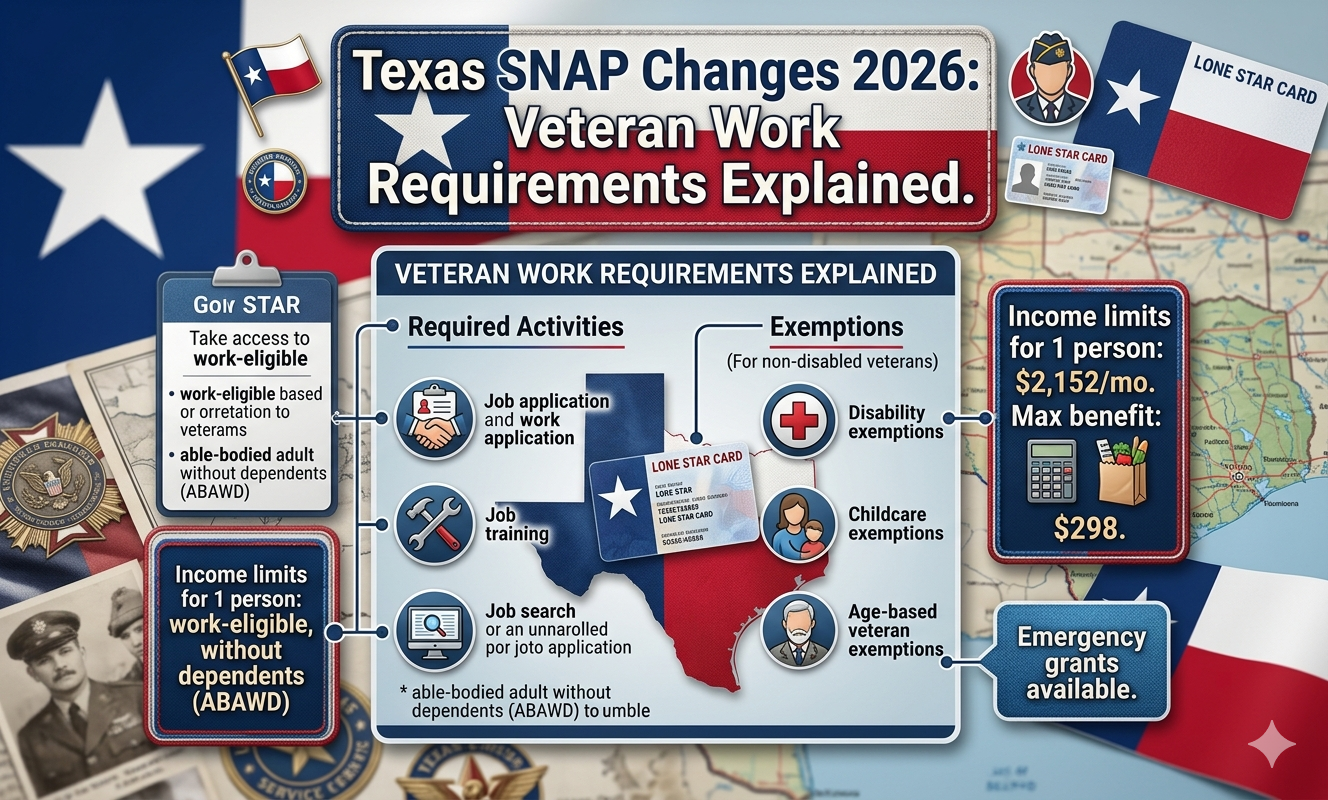
Instant Answer: Do You Have to Work for SNAP Benefits in 2026?
Yes, if you’re an adult between 18 and 64 years old, don’t have a disability exemption, and don’t live with a child under 14 in your SNAP household, you must complete 80 hours per month of work, volunteering, or approved training. If you don’t, you’ll lose SNAP after just 3 months in a 3-year period .
The old rules only applied to ages 18-54 and let veterans, homeless individuals, and former foster youth skip the requirement automatically. Those exemptions are gone as of 2026.
Here’s what that means in plain English: If you’re 55 years old, healthy, and your kids are grown, you now need to show 80 hours of work or volunteer activity every month—or your food benefits stop after three months.
What Americans Need to Know Right Now
States are implementing these rules on different schedules. Some started as early as October 2025. Others begin in March, June, or later in 2026 .
The three-month clock is ticking for millions. The Congressional Budget Office estimates about 2.4 million people will lose SNAP benefits over the next decade because of these changes .
If you work 30+ hours a week OR earn at least $217.50 weekly, you’re automatically exempt. You don’t need to do anything extra .
Don’t ignore mail from your state SNAP office.<span class=””> That notice telling you you’re an “ABAWD” means you need to act—or lose benefits.
Latest Updates Today on SNAP Work Requirements
As of June 2026, the D.C. Department of Human Services began screening all SNAP applicants and recertifications for ABAWD status. If you’re applying or renewing in D.C. on or after June 1, 2026, expect a review .
Georgia updated its work registration policy in January 2026 to align with the new federal rules. Mandatory registrants now include anyone 16+ who doesn’t qualify for an exemption .
New York counties started enforcement in March 2026. Clinton County now requires ABAWDs to submit documentation of their 80 monthly hours by the 10th of the following month .
Enrolled at least half-time in school, training, or higher education
American Indian/Alaska Native eligible for Indian Health Services
Real-Life Examples
Example 1: Maria, 58, lives alone and has no kids. She works 25 hours a week at a grocery store. She is subject to ABAWD rules because she works less than 30 hours and earns under $217.50/week. She needs to add 5 more hours of work or volunteer time to reach 80 hours monthly .
Example 2: James, 62, cares full-time for his wife who has MS. He doesn’t work. He is exempt because he cares for an incapacitated person, even though she’s not a SNAP household member .
Example 3: Teresa, 45, has a 12-year-old son living with her. She works 10 hours a week. She is exempt because she lives with a child under 14, regardless of her work hours .
How Much SNAP Help You Can Get
Monthly SNAP benefits for fiscal year 2026 (October 2025 – September 2026) :
For Current Recipients Worried About Work Requirements:
Step 1: Read every notice from your state SNAP office.<span class=””> Look for “ABAWD,” “Work Requirements,” or “Time Limit.”
Step 2: Determine if you’re exempt. Use the exemption list above. If any apply, report it to your caseworker immediately.
Step 3: If you’re NOT exempt, document 80 hours/month:
Paid work: Save pay stubs showing hours
Volunteer work: Get a letter from the organization on their letterhead
Training/education: Get enrollment or attendance verification
Step 4: Submit documentation by your state’s deadline. Some states require it monthly. New York’s Clinton County requires submission by the 10th of the following month . D.C. starts accepting forms June 1, 2026 .
Step 5: If you lose eligibility: You can regain benefits by showing you’ve met work requirements for a 30-day period. Example: Start a job, work 80+ hours that month, then reapply with proof .
Documents You’ll Need:
Government ID (driver’s license, state ID, passport)
Medical expense documentation (for disability exemption)
School enrollment verification (for student exemption)
Common Mistakes That Delay Approval or Lose Benefits
Mistake #1: Ignoring the ABAWD notice. If your state sends a letter saying you’re subject to work requirements, ignoring it won’t make it go away. You’ll lose benefits after 3 months of non-compliance .
Mistake #2: Not reporting exemptions. Being exempt doesn’t count unless you tell your caseworker. Pregnant? Caring for someone with a disability? Working 30+ hours? Report it.
Mistake #3: Assuming volunteer work doesn’t count. It does. Unpaid work, in-kind work (trading labor for rent/goods), and volunteering at nonprofits all count toward your 80 hours .
Mistake #4: Missing the monthly submission deadline. Some states require proof by the 10th of the following month. Mark your calendar .
Mistake #5: Falling for “SNAP work requirement” scams. No legitimate agency will ask for your Social Security number over the phone or demand payment to “keep your benefits.” Hang up and call your local SNAP office directly .
Mistake #6: Not updating your address. If your state can’t reach you, they can’t tell you about a work requirement notice. And you can’t comply with a notice you never got.
What This Means for Families in Real Life
For a single 56-year-old who lost their job: You have 3 months to find work or volunteer 80 hours monthly. After that, your $204 average SNAP benefit stops. That could mean choosing between food and rent .
For a 45-year-old parent with a 15-year-old: Your child is over 14, so you lose the automatic exemption. If you work part-time (say, 20 hours/week), you need to add 20 more hours of training or volunteering to keep benefits. That’s tough when you’re also managing a teenager’s schedule.
For a 62-year-old caring for a disabled spouse: You’re exempt. Breathe easy—but keep documentation of your caregiving role in case your state asks .
For a 55-year-old veteran: Before 2026, you were automatically exempt. Now you’re treated like everyone else. You need to work, volunteer, or train 80 hours/month or risk losing benefits after 3 months .
For a homeless individual: The previous exemption is gone. If you’re homeless and able to work, you’re subject to the same rules. Some states offer supportive services like bus passes and work clothing to help you comply .
For a family with a disabled adult child:<span class=””> If your 25-year-old with a disability lives with you, document that disability. They need a medical statement to prove unfitness for work and maintain their exemption .
Government and Political Context Behind the Update
What changed and why you should care right now.
In July 2025, President Trump signed the “One Big Beautiful Bill Act” into law. This massive spending and tax bill included major SNAP work requirement expansions .
Veterans, homeless individuals, former foster youth (up to age 24) were automatically exempt
Parents with children under 18 were exempt
States could easily waive requirements in high-unemployment areas
The new rules (active 2026):
Ages expanded to 18-64
Veterans, homeless, foster youth lost their automatic exemptions
Parents only exempt if child is under 14 (ages 14-17 no longer count)
State waivers now require unemployment rates over 10% —extremely rare
Why this happened: Republican lawmakers argued work requirements incentivize employment and reduce government dependency. The CBO estimates these changes will cut SNAP rolls by about 2.4 million people over 10 years, saving federal money .
The counterargument: Democrats and anti-hunger advocates point out that most SNAP recipients who can work already do. The Center on Budget and Policy Priorities found nearly 2 in 5 SNAP households include someone with a job . Critics say the new rules punish people in areas with few jobs, older workers facing age discrimination, and parents of teenagers who still need supervision.
What’s happening now: States are implementing on different schedules based on when their waivers expired. California’s waiver lasts until January 2027. New York started March 2026. D.C. started June 1, 2026. Texas started October 2025 .
Could this change again? The “Improving Access to Nutrition Act of 2026” would repeal these ABAWD work requirements entirely. But with divided government and the 2026 midterm elections approaching, its chances are uncertain .
Who qualifies for SNAP work requirement exemptions?
You’re exempt if you’re under 18 or 65+, pregnant, disabled, caring for a child under 14 or an incapacitated person, working 30+ hours/week, earning $217.50+/week, in school half-time, receiving unemployment, or in drug/alcohol treatment .
How much does SNAP pay per month?
Maximum for 1 person: $298. For 4 people: $994. Average per person: about $190. Actual amount depends on income and expenses .
Can I get SNAP if I work?
Yes. In fact, working helps you meet requirements. If you work 30+ hours or earn $217.50/week, you’re automatically exempt from ABAWD rules. Many SNAP recipients work—nearly 2 in 5 households include a worker .
How long does SNAP approval take?
Up to 30 days. Expedited cases (very low income, little cash on hand) get benefits within 7 days .
What documents are required for SNAP?
ID, Social Security cards, pay stubs (30 days), bank statements (if required), rent/mortgage statement, utility bills, medical expenses (if claiming disability), school enrollment (if student) .
Can college students get SNAP?
Yes, but with restrictions. Students enrolled at least half-time generally don’t qualify unless they work 20+ hours/week, participate in work-study, care for a child under 6, or receive TANF/SSI. Check your state’s rules .
What happens if I don’t meet SNAP work requirements?
You lose benefits after 3 non-compliant months within a 36-month period. You can regain eligibility by showing you’ve met requirements for a 30-day period (e.g., 80 hours of work in a month) .
Do I have to repay SNAP benefits if I made a mistake?
Usually, no—unless you intentionally committed fraud. If you made an honest mistake on your application, contact your caseworker to correct it. You may need to repay overpayments, but you won’t face criminal charges for an error .
Is the SNAP work requirement real or a scam?
It’s real. But scammers use the confusion to steal information. Legitimate agencies will never demand payment, ask for your Social Security number over the phone, or threaten immediate arrest. When in doubt, hang up and call your local SNAP office using a number from an official .gov website .
Final Takeaway
What changed: SNAP work requirements now apply to healthy adults ages 18-64 without children under 14. Veterans, homeless individuals, and former foster youth lost their automatic exemptions. The three-month time limit is real—and active now in most states.
Need help? Call your local SNAP office or 211 for referrals to free legal aid and community organizations that can help you navigate work requirements.