The Supplemental Nutrition Assistance Program (SNAP) in Alabama, commonly referred to as food stamps, serves as a crucial safety net for low-income households, aiming to alleviate hunger and improve nutritional standards. The program provides eligible individuals and families with financial assistance to purchase nutritious food, ensuring better health outcomes and increased food security.
Eligibility for SNAP in Alabama is determined by several factors, including income level, household size, and certain expenses such as housing costs. Generally, households with incomes at or below 130% of the federal poverty level are eligible to receive benefits. Additional considerations include the age, disability status, and citizenship of the applicants. For instance, households with elderly or disabled members may qualify for less stringent work requirements.
The importance of SNAP cannot be overstated, as it plays a vital role in supporting the well-being of families across Alabama. With over 1 million residents participating in the program, SNAP not only helps households to feed their members but also positively impacts local economies. By providing residents with the means to purchase food, the benefits are circulated back into the community, supporting local businesses and farmers.
Furthermore, SNAP is designed to adjust to the nutritional needs of its participants, allowing them to select food that aligns with their dietary requirements. Given the challenges posed by economic instability, the program serves as a lifeline, bridging the gap for those who may otherwise struggle to secure adequate nourishment.
Here is the most current information on Alabama SNAP (Food Stamps) for 2026, including important changes to work requirements that have already led to program changes in the state.
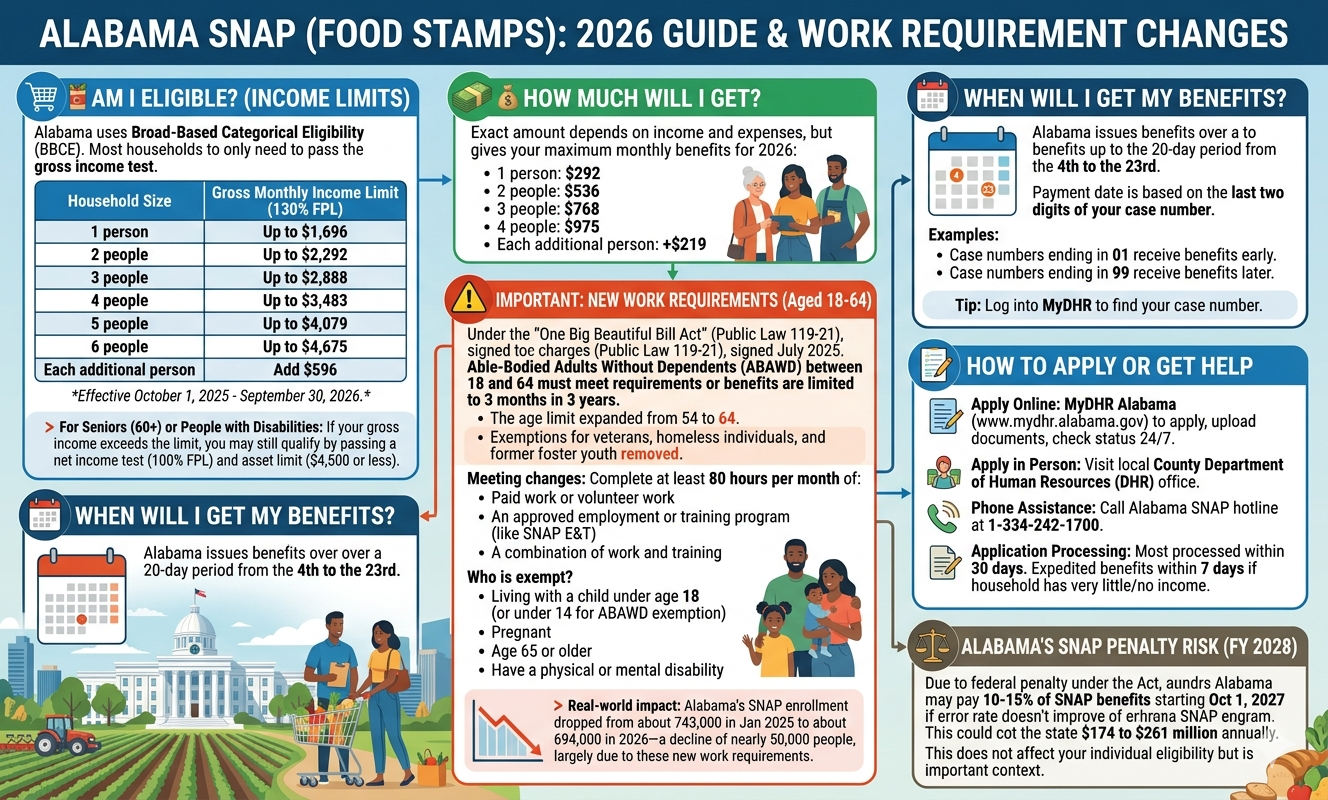
🥫 Am I Eligible? (Income Limits)
Alabama uses Broad-Based Categorical Eligibility (BBCE) , which simplifies the process. Most households only need to pass the gross income test—your home, car, and savings generally do not count against you .
These limits are effective October 1, 2025 through September 30, 2026 .
For Seniors (60+) or People with Disabilities: If your household includes a member who is 60 or older or has a disability and your gross income exceeds the limit above, you may still qualify by passing a net income test (100% FPL) and an asset limit of $4,500 or less in countable assets (cash, bank accounts) .
💰 How Much Will I Get?
The exact amount depends on your household’s income and expenses, but these are the maximum monthly benefits for the 2026 fiscal year (Oct 2025 – Sept 2026) :
1 person: $292
2 people: $536
3 people: $768
4 people: $975
Each additional person: +$219
⚠️ Important: New Work Requirements (Aged 18-64)
Work rules for SNAP changed significantly in 2026 under the “One Big Beautiful Bill Act” (Public Law 119-21), signed in July 2025 .
If you are classified as an Able-Bodied Adult Without Dependents (ABAWD) between the ages of 18 and 64, you must now meet specific requirements or your benefits will be limited to 3 months in a 3-year period .
Key changes include:
The age limit expanded from 54 to 64 .
Exemptions for veterans, homeless individuals, and former foster youth have been removed .
What counts as meeting the requirement? You must complete at least 80 hours per month of one of the following:
Paid work or volunteer work
An approved employment or training program (like SNAP E&T)
A combination of work and training
Who is exempt from these requirements?
Living with a child under age 18 (or under 14 for the ABAWD exemption)
Pregnant
Age 65 or older
Have a physical or mental disability
Real-world impact: Alabama’s SNAP enrollment dropped from about 743,000 in January 2025 to about 694,000 in 2026—a decline of nearly 50,000 people—largely due to these new work requirements .
📅 When Will I Get My Benefits?
Alabama issues SNAP benefits over a 20-day period each month, from the 4th to the 23rd .
Your specific payment date is based on the last two digits of your case number . For example:
Case numbers ending in 01 receive benefits early in the period.
Case numbers ending in 99 receive benefits later in the period.
You can log into your MyDHR account to find your case number if you don’t know it.
📝 How to Apply or Get Help
Apply Online: The official portal is MyDHR Alabama (www.mydhr.alabama.gov). You can apply, upload documents, and check your case status 24/7 .
Apply in Person: Visit your local County Department of Human Resources (DHR) office .
Phone Assistance: Call the Alabama SNAP hotline at 1-334-242-1700 .
Application Processing: Most applications are processed within 30 days. If your household has very little or no income, you may qualify for expedited benefits within 7 days .
⚖️ Alabama’s SNAP Penalty Risk (FY 2028)
Due to a federal penalty under the One Big Beautiful Bill Act, Alabama may be required to pay 10-15% of SNAP benefits starting October 1, 2027 if the state’s error rate does not improve . This could cost the state an estimated $174 to $261 million annually . This does not affect your individual eligibility but is important context for the program’s future in the state.
Would you like more details on how to upload documents to MyDHR or specific work training programs available in your county?
Overview of SNAP Changes in 2026
The Supplemental Nutrition Assistance Program (SNAP), commonly known as food stamps, continues to evolve in Alabama, with significant changes implemented in 2026. These modifications reflect ongoing efforts to address food insecurity while ensuring efficient use of resources and compliance with federal regulations. One notable change involves an alteration in eligibility criteria, specifically regarding income limits and household composition. In 2026, the income eligibility thresholds have been adjusted to accommodate the rising cost of living, meaning more individuals and families may qualify for assistance.
In addition to adjustments in income limits, the benefits provided under SNAP have also seen revisions. The maximum allotment for benefits has increased, allowing recipients greater purchasing power for essential food items. This increase is particularly relevant as inflation continues to impact the prices of groceries across the state. Stakeholders within the program have emphasized the importance of these adjustments to meet the nutritional needs of Alabama’s vulnerable populations.
Furthermore, modifications to the application and renewal processes have been enacted to streamline access to SNAP benefits. A focus on digital tools has been introduced, encouraging applicants to utilize online platforms for submitting applications and documentation. This shift aims to simplify the experience for users and reduce processing times. The state has also announced a series of outreach initiatives designed to educate the public on these changes and promote awareness of available resources.
Lastly, work requirements for certain SNAP recipients will also see new stipulations come into play in 2026. These updates aim to balance the need for individuals to seek employment while still providing essential support for those who require it. It is essential to stay informed about these changes as they not only affect eligibility but also the overall experience of recipients navigating the program.
New Work Requirements for SNAP Participants
As of 2026, significant changes have been introduced to the Supplemental Nutrition Assistance Program (SNAP) in Alabama, particularly concerning work requirements for beneficiaries. The intent behind these reforms is to encourage self-sufficiency among participants and to instill a sense of responsibility towards employment. Under these updated rules, individuals aged 18 to 49 without dependents must now meet specific criteria to remain eligible for SNAP benefits.
To qualify for these benefits, participants are required to engage in a minimum of 20 hours per week of work, job training, or community service. Work activities recognized under these new stipulations include traditional employment, structured job training programs, and volunteer positions that contribute to the community. Moreover, students enrolled in qualifying educational programs are also exempt from these work requirements, allowing them to focus on their studies while receiving assistance.
Failure to comply with the stipulated work requirements may result in penalties, including a temporary loss of benefits. For first-time noncompliance, beneficiaries will face a three-month suspension of assistance. Subsequent failures can lead to a longer disqualification period, underscoring the importance of understanding and adhering to these new regulations.
The Alabama Department of Human Resources is actively working to implement these changes, aiming to provide resources and support for beneficiaries attempting to meet these new work requirements. Through workshops and informational sessions, the department seeks to inform individuals of their options and ensure they understand the pathways available for compliance, thereby enhancing their opportunities for economic stability.
Impact of Work Requirements on SNAP Beneficiaries
The implementation of new work requirements for SNAP beneficiaries in Alabama has generated significant changes in the way individuals access and maintain their benefits. These requirements emphasize the necessity for able-bodied adults without dependents (ABAWDs) to engage in work-related activities such as employment, job training, or education for a minimum number of hours each week. This policy shift aims to encourage workforce participation but has also led to an array of consequences for numerous participants in the program.
According to recent statistics from the Alabama Department of Human Resources, following the introduction of work requirements, a notable percentage of beneficiaries have faced challenges in meeting the stipulated criteria. For instance, data indicates that in the first quarter of 2026, approximately 25% of eligible ABAWDs failed to comply with the work requirements, resulting in a loss of benefits. Many individuals reported difficulties in obtaining suitable employment, with limited job opportunities and various economic factors impacting their ability to work reliably.
Case studies further illustrate these outcomes. In one example, a single parent attempting to secure a full-time job encountered barriers such as inadequate childcare services and transportation issues that hindered their ability to fulfill work obligations. Consequently, this individual lost SNAP benefits, which exacerbated their financial burden and negatively affected their household’s food security. In another instance, a participant enrolled in a job training program was unable to complete the required hours due to unforeseen circumstances, leading to a similar loss of benefits.
As the landscape of SNAP evolves with the reinforcement of work requirements, it is clear that while the intention may be to promote self-sufficiency, the practical implications for beneficiaries require thoughtful examination and potentially, modifications to ensure that vulnerable populations are not unduly harmed in the process.
Resources for SNAP Recipients in Alabama
For individuals and families participating in the Supplemental Nutrition Assistance Program (SNAP) in Alabama, various resources and support services are available to assist them in maximizing their benefits and improving their overall well-being. Understanding and accessing these resources can significantly enhance food security and provide educational opportunities.
One primary resource is the Alabama Department of Human Resources (DHR), which oversees the SNAP program. The DHR’s website offers comprehensive information on eligibility, application procedures, and program updates. Additionally, local DHR offices can help recipients with face-to-face assistance, providing support tailored to individual needs.
Community Action Agencies (CAAs) throughout Alabama also provide vital resources for SNAP beneficiaries. These agencies can assist with food distribution, budgeting workshops, and employment services. By connecting with a local CAA, SNAP recipients can receive targeted assistance that suits their circumstances.
Hotlines are another crucial asset for individuals seeking immediate help. The Alabama SNAP Outreach Program has a dedicated hotline that provides information on SNAP benefits and eligibility requirements. Recipients can reach trained professionals who can answer questions and guide them through the application process.
In addition to these services, educational programs focused on nutrition and cooking are available to SNAP users. Programs such as the Expanded Food and Nutrition Education Program (EFNEP) offer training on healthy meal preparation on a budget, helping recipients to make informed food choices. These workshops often occur in community centers, schools, and online platforms, making them accessible to various audiences.
Overall, these resources aim to empower SNAP recipients in Alabama, ensuring that they not only receive assistance but also have the tools and knowledge necessary to use their benefits effectively.
Future Projections for Alabama SNAP
As the Supplemental Nutrition Assistance Program (SNAP) evolves in Alabama, a variety of factors are informing future projections regarding the program. Both state-level and federal policy discussions are anticipated to bring significant changes over the next few years, especially in light of emerging trends related to food security, economic conditions, and shifting regulatory landscapes.
One of the most prominent considerations is the potential for increased funding for SNAP benefits. In Alabama, as food prices continue to rise and the cost of living increases, state policymakers may advocate for adjustments to benefit levels to better meet the needs of low-income families. These adjustments could involve an examination of how benefits are disbursed and whether alternative models, such as cash assistance, could supplement existing food assistance programs.
Another critical area of focus is the work requirements associated with SNAP. Currently, certain able-bodied adults without dependents (ABAWDs) must meet specific employment criteria to remain eligible. However, discussions are ongoing about whether these requirements should be modified or relaxed given the impact of economic fluctuations and labor shortages. Enhancements in job training programs could also be on the horizon, aimed at increasing the employability of SNAP beneficiaries.
Technological advancements are expected to play a crucial role in how SNAP operates in the future. The implementation of digital tools for application processing and benefits distribution may help streamline access to services, thereby supporting greater efficiency and reducing fraud. Enhancements in data tracking could also provide insights into program effectiveness, leading to informed policy decisions that better support the needs of Alabama residents.
Overall, while the future of Alabama’s SNAP program is subject to change, ongoing discussions at various governmental levels indicate a thoughtful approach to improving food security and bolstering the economic stability of its residents. Continuous monitoring of these trends will be vital to understanding how SNAP will adapt and evolve in response to the challenges facing low-income households.
To initiate your application online, you can visit the Alabama Department of Human Resources (ADHR) website, where you will find the SNAP application portal. First, create an account if you do not already have one; this will allow you to track your application status and receive notifications regarding updates. Once logged in, complete the form by providing accurate personal information, including your household details, income, and expenses.
It is essential to gather the required documentation beforehand to facilitate the process. Generally, you will need proof of identity (such as a driver’s license or state ID), Social Security numbers for all household members, and information regarding income—this may include pay stubs or tax returns. Other documents, like rent or mortgage receipts and utility bills, can also support your application.
If you prefer to apply in person, you can visit your local county Department of Human Resources office. Make sure to bring all necessary documents with you, as this will aid in the speedy processing of your application. During your visit, staff members will assist you in filling out the application form if needed.
Whichever method you choose, it is crucial to submit your application promptly. Once submitted, the ADHR will review your application and provide a decision within a few weeks. You may receive a notice requesting additional information, so staying responsive is vital to avoid delays in receiving your benefits.
Common Questions about SNAP in Alabama
The Supplemental Nutrition Assistance Program (SNAP), commonly referred to as food stamps, provides critical assistance to those experiencing food insecurity in Alabama. To navigate this program effectively, it is important to address common questions surrounding its eligibility, benefit calculations, and renewal processes.
One key query pertains to eligibility requirements for SNAP in Alabama. Generally, applicants must meet income and resource limits, which are evaluated based on household size. Specifically, gross monthly income should not exceed 130% of the federal poverty level, ensuring that benefits are directed towards those most in need. Additionally, certain resources, such as a home, vehicle, and retirement accounts, are exempt from consideration, making it possible for many individuals to qualify based on their circumstances.
Another frequently asked question involves how benefits are calculated. SNAP benefits are determined by the USDA’s Thrifty Food Plan, which considers the number of individuals in a household. Once eligibility is confirmed, the calculation involves assessing monthly income against allowable deductions, which may include housing costs, childcare expenses, and medical costs for elderly or disabled members. As such, providing thorough and accurate information regarding household expenses during application can greatly influence the benefit amount awarded.
Lastly, inquiries often arise regarding the renewal process for SNAP benefits. In Alabama, recipients are typically required to renew their benefits every six months to one year, depending on their circumstances. At the time of renewal, recipients must submit updated information on their income and resources, ensuring that their benefits reflect any changes in their financial situation. Failing to complete the renewal process can result in a lapse in benefits, so it is advisable for participants to stay informed of renewal dates and requirements.
Conclusion and Call to Action
In conclusion, the Supplemental Nutrition Assistance Program (SNAP) in Alabama is undergoing significant revisions and updates in 2026 that are poised to affect recipients across the state. This year, we have outlined key changes, including adjustments to eligibility requirements and the introduction of expanded work mandates. These modifications are critical as they aim to align with current economic conditions and evolving community needs.
With enhanced work requirements becoming a focal point, it is essential for individuals and families depending on food stamp assistance to stay informed about these developments. Participating in local workshops or informational sessions can provide valuable insights and guide recipients on how to maintain their benefits while complying with the new stipulations. Furthermore, community organizations are increasingly gearing their efforts toward assisting those affected by these changes, making it vital for SNAP participants to engage with available resources.
We encourage our readers to advocate for policies that strengthen food security and ensure that assistance programs like SNAP remain accessible to those in need. By voicing concerns to local representatives and supporting initiatives aimed at combating food insecurity, constituents can play a significant role in shaping a supportive environment for all Alabamians in need. As we move forward, staying updated and active in our communities will ensure that we not only understand the changes but also contribute to a comprehensive support system for vulnerable populations.